• Skip to main content
  • Skip to primary sidebar

Patti Cotton

Executive Coach & Career Strategist

  • About
  • Consulting
  • Training
  • Speaking
  • Blog
  • Contact

Patti Cotton

Before You Welcome 2017

December 28, 2016 By Patti Cotton Leave a Comment

shutterstock_116575999a-New Year 2017

A Brief Check-In For Women Who Lead

As a woman who leads, you have probably experienced a full and exciting year. You have no doubt also had to deal with some unusual experiences, which have demanded quite a bit of your time.

What this means is that you may have set some important goals aside in order to accomplish the essential.

My wish for you is that you do not close the door on 2016 with regrets…that you take a moment to reflect on the things that you have accomplished. Because all too often, we focus on the things we didn’t do, diminishing the importance of our successes.

And instead of feeling excited about 2017, you’ll feel like you are in “catch up” mode – not a healthy, strategic approach, or a good feeling.

Assessing your 2016 wins is critical to having the right lens to set your goals for 2017.

So before you welcome 2017, here’s a brief check-in…

Celebrating Your 2016 Wins and Successes

Find a quiet corner and hot cup of something good, take a pen and paper, and settle in to answer the following questions (it’s important to hand write this in order to connect your head and heart):

  1. What are you most proud of, as you look back at 2016? (This may be personal or business – but it would be great to list one for each.)
  1. List 3-5 wins in your work – accomplishments or moves forward.
  1. What one thing would you like to congratulate yourself for, which others may or may not have noticed?
  1. What values do these accomplishments reveal?
  1. What natural strengths did you use in order to accomplish these things?
  1. What event or circumstance in your life this year opened the door for you to recognize your power or influence your future choices?
  1. What did you do well in 2016 that you would like to do more of in 2017?
  1. What do you need to make sure that your goal-setting process for 2017 is an exciting and positive one – one that energizes and excites you?
  1. Knowing you have put some things aside in order to accomplish “the necessary,” what is one thing you would like to focus on in 2017 that will make a difference to your year?

Taking time to reflect on these things is important to your success in 2017. I’d love to hear what this exercise brought up for you. Join me on LinkedIn to share, and for more discussion…


Patti Cotton helps women executives optimize their effectiveness in leading self, others, and enterprises. Her areas of focus include confidence, leadership style, executive presence, effective communication, and masterful execution. With over 25 years of leadership experience, both stateside and abroad, Patti works with individuals, teams, and organizations across industries, providing executive coaching, women’s leadership development, change, and conflict management. She is also a Fortune 500 speaker. For more information on how Patti Cotton can help you and your organization, click here.

Patti Cotton

Patti Cotton reenergizes talented leaders and their teams to achieve fulfillment and extraordinary results. For more information on how Patti Cotton can help you and your organization, click here.

Why Women Leaders Are Losing Their Jobs

December 21, 2016 By Patti Cotton Leave a Comment

shutterstock_121223512a

3 Ways You Can Avoid This

Fortune Magazine’s December 13, 2016 blog, “The World’s Most Powerful Women,” reports that women business leaders around the world are losing ground.

“This year has been a doozy for supporters of gender equality and women’s advancement, even beyond Hillary Clinton’s defeat and Donald Trump’s victory.

  • Dilma Rousseff, Brazil’s first female president, was ousted from power, and
  • South Korea’s first female president, Park Geun-hye, now seems poised to meet that same fate.
  • The IMF’s first female chief, Christine Lagarde, is currently engulfed in a trial that could jeopardize her future.
  • The number of female CEOs in the Fortune 500 sank from 24 to 21.
  • And some bright, still rising business stars – Theranos’ Elizabeth Holmes, Yahoo’s Marissa Mayer – have plummeted like fireballs back to earth.”

The unfortunate consequence of these disappointing events is that because this is occurring on a larger, public scale, your brain is subconsciously telling the following story:

“Hey, You, women just can’t hack it. See what happens when a woman is placed in a position of leadership? Don’t try it. It doesn’t work. Be safe. Be warm. Stay where you are. Don’t try to reach higher goals. Don’t speak up. Don’t speak out.”

In fact, most all of these situations Forbes describes were avoidable – and that’s what your brain doesn’t stop to examine. The women mentioned in the Forbes blog have lost their positions for many reasons, and some are as follows:

  • poor decision-making, difficulties in taking action
  • not asking for help or an inability to listen
  • surrounding themselves with the wrong people
  • difficulty in building the influence they need to get support and get things done
  • staying too long in the same position when they should have made that next move or change

Of course, politics can sometimes derail. And, in at least one disappointing case, compromised ethics were at issue.

But for the most part, the plummets these female business leaders have taken were avoidable. And that’s just plain disappointing after all we’ve worked on to move forward.

So, how can you avoid the same kind of ending?

These recent events with other women of high visibility can hurt you and your future, if you are aspiring to greater leadership and larger opportunities.

The simple answer is to get the right kind of help to check you on your ability to lead and do it well. This involves a few things.

1. Be willing to examine your own leadership.

How well do you lead yourself – your emotions and the way you manage these, as well as your decision-making, action-taking, and more. Take an assessment, and review whether you are meeting goals effectively, if you have rock-solid confidence, and if your business or company recognizes your value.

2. Be willing to ask a few trusted colleagues and mentors where you need to grow.

How well are you leading others? How do you relate, build influence, and get things done with others? Take the basal temperature by getting sound feedback so you know what to work on. If you are great talent, but you can’t communicate this to others and influence them to take action, your leadership will stall here.

3. Get the right kind of help to grow your leadership in the right places, and through the right way.

Don’t be shy, and don’t short-change yourself. This is what kills most women leaders “in the making” – not asking for help, and not investing in the right kind. You must make the investment in yourself to course-correct and camp on your abilities so that these work for you, and work extremely well. For more on this, see my special report “Coaches, Mentors, and Sponsors: The Differences and the Benefits.”


In thinking about your own leadership aspirations, where, in your own leadership, might you need to grow?  Join us on LinkedIn to share, and for more discussion.


Patti Cotton helps women executives optimize their effectiveness in leading self, others, and enterprises. Her areas of focus include confidence, leadership style, executive presence, effective communication, and masterful execution. With over 25 years of leadership experience, both stateside and abroad, Patti works with individuals, teams, and organizations across industries, providing executive coaching, women’s leadership development, change, and conflict management. She is also a Fortune 500 speaker. For more information on how Patti Cotton can help you and your organization, click here.

Patti Cotton

Patti Cotton reenergizes talented leaders and their teams to achieve fulfillment and extraordinary results. For more information on how Patti Cotton can help you and your organization, click here.

When “Just Do It” Doesn’t Work: Testing Out of Fear

December 14, 2016 By Patti Cotton Leave a Comment

shutterstock_133645907a

How do you move past fear?

You don’t.

You get underneath it.

You get underneath the fear to the faulty assumptions that are driving it.

Underneath every instance where your confidence falters, or wherever a fear surfaces, there lies a hidden set of faulty assumptions that acts like glue to keep this fear intact.

Ready to break through?

I work with successful executives and business owners who are ready to step into a next level of success. A lot of times, they engage me because they have an incredible vision for their future or special project, or they have just assumed a new and larger role. These scenarios require bigger ways of thinking, acting, and doing, and even the most confident people will find themselves stalled by fears they didn’t realize would emerge.

A client I will call Mara asked me to help her make the move from being a very successful attorney to founding her own consulting firm. This was a major decision for her, but she was convicted and passionate about the change. She had already done all the homework – researching the need for services, defining the value she could bring to the client, weighing the costs and benefits this move would have on her financial future, identifying resources and connecting with key mentors for the help she would need, and putting together a plan of action to actually build the business.

But she called me for support because she couldn’t seem to move forward in working the plan. Specifically, Mara was afraid she would fail as a business owner. Even though she had gone through the planning steps that would support her success, she still feared she would not make it.

I asked her what was behind this fear, and Mara’s faulty assumptions were then revealed.

“Mara, what are you afraid will happen if you fail?”

“Well, other people might think I don’t have what it takes as a business person.”

“Mara, what are you afraid is going to happen if that happens?”

“Well, if others think I don’t have what it takes, I will lose credibility and no one will engage me.”

“And if that happens?”

“Then I’ll lose my home and be homeless – and others will have to take care of me. I will become a non-person – no worth.”

And there it was – the underlying faulty assumption that held Mara back. She feared she would become a non-person, a person of no worth. This was the glue that held her fear together.

“Mara, is it really true that if you fail in business that you will become homeless and of no worth?”

“Well, no – I have a good savings, and a corner on my specialty within law. I could always return with no problem. You know – it’s weird!  I didn’t know that underneath all this was a fear that I would become a non-person. That’s not true!”

And yet, this was what was holding her back – the story she told herself, made up of a subconscious set of faulty assumptions that held her fear together like glue.

“Then, how do you get rid of the fear?” Mara asked me. “Because I can tell you that the old Nike adage, ‘Just do it!’ does not work for me.”

“Here’s what you do,” I answered. “You change your story to get rid of the fear. To do this, you don’t confront the fear – you confront the assumptions.”

Confronting the assumptions is confronting the story you are telling yourself, because it is the story that keeps your fear intact. Confronting your assumptions asks that you experiment with scenarios to see if your story is true. But contrary to the adage “Just do it,” by confronting the fear, confronting assumptions to break through fear is more powerful and effective.

Let’s say that you tell yourself that you are afraid to jump in the water because you assume the swimming pool is too cold to get in and swim. So the story you tell yourself is that if you jump in, you will catch a chill and be miserable. If you are miserable, then you will have to stay at home and nurse a cold. And if you stay at home to nurse a cold, you will miss out on all the fun planned for the weekend. And if this happens, well…(you see what I mean!).

To begin testing out of these faulty assumptions, you walk to the edge of the pool. You dip the tips of your toes in the water to see if your foot will be okay with the temperature. It may be a little chilly, but once you see that the toes are fine, you put a bit more of your foot in and go through the same exercise, asking yourself if you are okay. Eventually, you are in the pool up to your neck, enjoying a swim, sun on your face, and wondering why you ever feared the water temperature.

What you are doing throughout this exercise is to stretch your level of comfort bit by bit, pausing each time to observe to see whether your assumptions are true or not. In doing so, you test out of these assumptions by proving them wrong. Once you do this, your mind tells itself a new story. “Hmmm…  I guess I don’t need to fear this fear anymore – it was completely unfounded.”  So an hour later, if you choose to go back for another swim, you will simply jump in this time, total body. No more fear.

So how did this process work for Mara?

Mara and I devised a plan that incorporated several critical testing points as she moved forward to found her own business. And the results were that over the next 9 months, she was able to cultivate several prospective clients and to secure contracts that would support her over the following 24 months. She gave notice at the law offices, and jumped into her own consulting firm full-time.

“I can’t believe I was afraid of failing,” Mara told me. “Granted, building a business can be extremely challenging – but it’s so rewarding, too. I realize through having cultivated those clients, I am quite capable.”

How about you? What fear is holding you back? What story are you telling yourself to keep this fear intact? Join us on LinkedIn to share, and for more discussion.


Patti Cotton helps women executives optimize their effectiveness in leading self, others, and enterprises. Her areas of focus include confidence, leadership style, executive presence, effective communication, and masterful execution. With over 25 years of leadership experience, both stateside and abroad, Patti works with individuals, teams, and organizations across industries, providing executive coaching, women’s leadership development, change, and conflict management. She is also a Fortune 500 speaker. For more information on how Patti Cotton can help you and your organization, click here.

Patti Cotton

Patti Cotton reenergizes talented leaders and their teams to achieve fulfillment and extraordinary results. For more information on how Patti Cotton can help you and your organization, click here.

Getting Your Bold On

December 7, 2016 By Patti Cotton Leave a Comment

shutterstock_229429621a

Are You a Gambler or a Calculated Risk-Taker?

There’s a fine line between taking a calculated risk and being a reckless gambler – and you can win or lose big, either way. However, in today’s business world, it is necessary to take risks in order to remain competitive and ahead of the game.

How do you do it so you don’t lose your shirt?

Whether you are an executive, business owner, or other professional, risk-taking is a key factor in your ability to lead yourself and others into the future. It affects your direction, decision-making, choices, and actions. It is the difference between becoming a Vera Wang or Elon Musk – or a Jane Doe or Joe Blow.

Can you become a calculated risk-taker – and win?

Deborah Perry Piscione, author of Risk Factor, says yes. Piscione, a member of former congressional and White House staff, as well as a media commentator for several key news channels, now supports some of the greatest risk-takers in Silicon Valley where technology history is made. She and some of her colleagues have conducted research that reveals the “DNA” of bold risk-takers, and they have discovered several key attributes – all of which can be cultivated.

These traits include such things as refusing to accept the status quo, being in touch with a much greater purpose in life, valuing talented people and understanding how and when to collaborate with them, and being able to effectively execute an innovative idea or direct others as they do it.

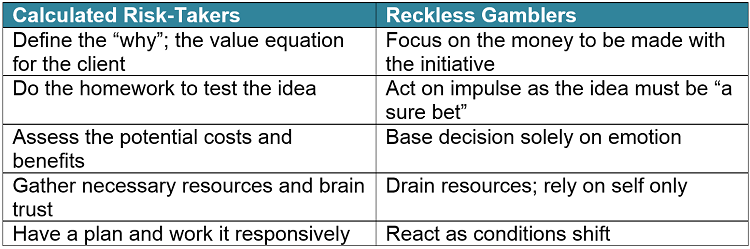
Indeed, in my coaching practice, I’ve observed 5 ways accomplished risk-takers differentiate themselves from gamblers:

risk_chart

But at the foundation of all of this is to have a lower level of fear than most people, or even an absence of fear. Because it is fear that keeps us from considering those decisions and actions that are outside of the box, and that will take our business and career from safe and small to extraordinary.

So we tell ourselves that people must just be born with a risk-taking quotient, and that it doesn’t run in our family. This is our excuse for removing ourselves from the equation. We then step back into our ordinary space, playing it safe and small, while others take the leaps and celebrate the rewards.

However, risk-taking isn’t a genetic trait – it’s acquired. You can, at any age, acquire the tools, skills, and knowledge to become a calculated risk-taker, and learn to avoid the pitfalls of those encountered by the reckless gambler.

So it’s back to confronting and overcoming the fear, because the approach to risk-taking can be learned. I’ll be writing about a specific method I use with clients to do this in my next article.

But meanwhile, what fear is holding you back from getting what you want?  And how do you move past it? Join us on LinkedIn to share, and for more discussion.

—

Patti Cotton helps women executives optimize their effectiveness in leading self, others, and enterprises. Her areas of focus include confidence, leadership style, executive presence, effective communication, and masterful execution. With over 25 years of leadership experience, both stateside and abroad, Patti works with individuals, teams, and organizations across industries, providing executive coaching, women’s leadership development, change, and conflict management. She is also a Fortune 500 speaker. For more information on how Patti Cotton can help you and your organization, click here.

Patti Cotton

Patti Cotton reenergizes talented leaders and their teams to achieve fulfillment and extraordinary results. For more information on how Patti Cotton can help you and your organization, click here.
Moving to the Front of the Leadership Pipeline

November 30, 2016 By Patti Cotton Leave a Comment

shutterstock_171066704a

3 Things You Need to Do Now

Are you thinking about moving into higher leadership? There’s some stiff competition out there.

Being seen and selected as “number 1” when it comes to moving up requires more than just being top talent. It requires that you shift how you think, act, and relate.

Many new executives and ascending leaders often think they will see what to do once they “get there.”  That’s a big mistake.

You can move to the front of the line quickly by mentally stepping into a leadership position before you get there.

Here are three of the most important steps to begin developing, today:

  1. Develop a wider lens. As you look at your area of responsibility, ask yourself how your area impacts not only other departments, but the organization and its vision. Begin connecting these dots and extend them outside the company to the industry, and to the marketplace. Starting to make wider and higher-level connections as you review your impact will develop your visionary “eye” and strategic thinking skills at new levels.
  2. Refine your decision-making and action-taking skills. When you make the move to more senior leadership, you’ll be moving away even more from the practice of your profession, and much closer to strategy, based on the information your team brings you. Ask yourself if you presently take too much time ruminating on decisions, or if you hesitate in taking action. And ask yourself if you trust your team – do you need to focus more on their development as you move forward? You will want to get in the habit of this with those who support you.
  3. Forge your leadership identity. Making sure that your leadership identity is strong and that it engenders trust and influence. Your distinct leadership “DNA” should be so distinctive that others can easily describe it in value-based terms. Forging this professional ascending will result in followership, leveraging the impact you are able to make.

Ready to go the front of the leadership pipeline? What’s your next move?  Join us on LinkedIn to share, and for more discussion.


Patti Cotton helps women executives optimize their effectiveness in leading self, others, and enterprises. Her areas of focus include confidence, leadership style, executive presence, effective communication, and masterful execution. With over 25 years of leadership experience, both stateside and abroad, Patti works with individuals, teams, and organizations across industries, providing executive coaching, women’s leadership development, change, and conflict management. She is also a Fortune 500 speaker. For more information on how Patti Cotton can help you and your organization, click here.

Patti Cotton

Patti Cotton reenergizes talented leaders and their teams to achieve fulfillment and extraordinary results. For more information on how Patti Cotton can help you and your organization, click here.

  • « Go to Previous Page
  • Page 1
  • Interim pages omitted …
  • Page 40
  • Page 41
  • Page 42
  • Page 43
  • Page 44
  • Interim pages omitted …
  • Page 54
  • Go to Next Page »

Primary Sidebar

Patti Cotton
Tweets by @PattiCotton
  • About
  • Consulting
  • Training
  • Speaking
  • Blog
  • Contact
Home | Contact | Privacy Policy

© 2024 Cotton Group LLC | PATTI COTTON 360° LEADERSHIP®