• Skip to main content
  • Skip to primary sidebar

Patti Cotton

Executive Coach & Career Strategist

  • About
  • Consulting
  • Training
  • Speaking
  • Blog
  • Contact

Blog

When “Just Do It” Doesn’t Work: Testing Out of Fear

December 14, 2016 By Patti Cotton Leave a Comment

shutterstock_133645907a

How do you move past fear?

You don’t.

You get underneath it.

You get underneath the fear to the faulty assumptions that are driving it.

Underneath every instance where your confidence falters, or wherever a fear surfaces, there lies a hidden set of faulty assumptions that acts like glue to keep this fear intact.

Ready to break through?

I work with successful executives and business owners who are ready to step into a next level of success. A lot of times, they engage me because they have an incredible vision for their future or special project, or they have just assumed a new and larger role. These scenarios require bigger ways of thinking, acting, and doing, and even the most confident people will find themselves stalled by fears they didn’t realize would emerge.

A client I will call Mara asked me to help her make the move from being a very successful attorney to founding her own consulting firm. This was a major decision for her, but she was convicted and passionate about the change. She had already done all the homework – researching the need for services, defining the value she could bring to the client, weighing the costs and benefits this move would have on her financial future, identifying resources and connecting with key mentors for the help she would need, and putting together a plan of action to actually build the business.

But she called me for support because she couldn’t seem to move forward in working the plan. Specifically, Mara was afraid she would fail as a business owner. Even though she had gone through the planning steps that would support her success, she still feared she would not make it.

I asked her what was behind this fear, and Mara’s faulty assumptions were then revealed.

“Mara, what are you afraid will happen if you fail?”

“Well, other people might think I don’t have what it takes as a business person.”

“Mara, what are you afraid is going to happen if that happens?”

“Well, if others think I don’t have what it takes, I will lose credibility and no one will engage me.”

“And if that happens?”

“Then I’ll lose my home and be homeless – and others will have to take care of me. I will become a non-person – no worth.”

And there it was – the underlying faulty assumption that held Mara back. She feared she would become a non-person, a person of no worth. This was the glue that held her fear together.

“Mara, is it really true that if you fail in business that you will become homeless and of no worth?”

“Well, no – I have a good savings, and a corner on my specialty within law. I could always return with no problem. You know – it’s weird!  I didn’t know that underneath all this was a fear that I would become a non-person. That’s not true!”

And yet, this was what was holding her back – the story she told herself, made up of a subconscious set of faulty assumptions that held her fear together like glue.

“Then, how do you get rid of the fear?” Mara asked me. “Because I can tell you that the old Nike adage, ‘Just do it!’ does not work for me.”

“Here’s what you do,” I answered. “You change your story to get rid of the fear. To do this, you don’t confront the fear – you confront the assumptions.”

Confronting the assumptions is confronting the story you are telling yourself, because it is the story that keeps your fear intact. Confronting your assumptions asks that you experiment with scenarios to see if your story is true. But contrary to the adage “Just do it,” by confronting the fear, confronting assumptions to break through fear is more powerful and effective.

Let’s say that you tell yourself that you are afraid to jump in the water because you assume the swimming pool is too cold to get in and swim. So the story you tell yourself is that if you jump in, you will catch a chill and be miserable. If you are miserable, then you will have to stay at home and nurse a cold. And if you stay at home to nurse a cold, you will miss out on all the fun planned for the weekend. And if this happens, well…(you see what I mean!).

To begin testing out of these faulty assumptions, you walk to the edge of the pool. You dip the tips of your toes in the water to see if your foot will be okay with the temperature. It may be a little chilly, but once you see that the toes are fine, you put a bit more of your foot in and go through the same exercise, asking yourself if you are okay. Eventually, you are in the pool up to your neck, enjoying a swim, sun on your face, and wondering why you ever feared the water temperature.

What you are doing throughout this exercise is to stretch your level of comfort bit by bit, pausing each time to observe to see whether your assumptions are true or not. In doing so, you test out of these assumptions by proving them wrong. Once you do this, your mind tells itself a new story. “Hmmm…  I guess I don’t need to fear this fear anymore – it was completely unfounded.”  So an hour later, if you choose to go back for another swim, you will simply jump in this time, total body. No more fear.

So how did this process work for Mara?

Mara and I devised a plan that incorporated several critical testing points as she moved forward to found her own business. And the results were that over the next 9 months, she was able to cultivate several prospective clients and to secure contracts that would support her over the following 24 months. She gave notice at the law offices, and jumped into her own consulting firm full-time.

“I can’t believe I was afraid of failing,” Mara told me. “Granted, building a business can be extremely challenging – but it’s so rewarding, too. I realize through having cultivated those clients, I am quite capable.”

How about you? What fear is holding you back? What story are you telling yourself to keep this fear intact? Join us on LinkedIn to share, and for more discussion.


Patti Cotton helps women executives optimize their effectiveness in leading self, others, and enterprises. Her areas of focus include confidence, leadership style, executive presence, effective communication, and masterful execution. With over 25 years of leadership experience, both stateside and abroad, Patti works with individuals, teams, and organizations across industries, providing executive coaching, women’s leadership development, change, and conflict management. She is also a Fortune 500 speaker. For more information on how Patti Cotton can help you and your organization, click here.

Patti Cotton

Patti Cotton reenergizes talented leaders and their teams to achieve fulfillment and extraordinary results. For more information on how Patti Cotton can help you and your organization, click here.

Getting Your Bold On

December 7, 2016 By Patti Cotton Leave a Comment

shutterstock_229429621a

Are You a Gambler or a Calculated Risk-Taker?

There’s a fine line between taking a calculated risk and being a reckless gambler – and you can win or lose big, either way. However, in today’s business world, it is necessary to take risks in order to remain competitive and ahead of the game.

How do you do it so you don’t lose your shirt?

Whether you are an executive, business owner, or other professional, risk-taking is a key factor in your ability to lead yourself and others into the future. It affects your direction, decision-making, choices, and actions. It is the difference between becoming a Vera Wang or Elon Musk – or a Jane Doe or Joe Blow.

Can you become a calculated risk-taker – and win?

Deborah Perry Piscione, author of Risk Factor, says yes. Piscione, a member of former congressional and White House staff, as well as a media commentator for several key news channels, now supports some of the greatest risk-takers in Silicon Valley where technology history is made. She and some of her colleagues have conducted research that reveals the “DNA” of bold risk-takers, and they have discovered several key attributes – all of which can be cultivated.

These traits include such things as refusing to accept the status quo, being in touch with a much greater purpose in life, valuing talented people and understanding how and when to collaborate with them, and being able to effectively execute an innovative idea or direct others as they do it.

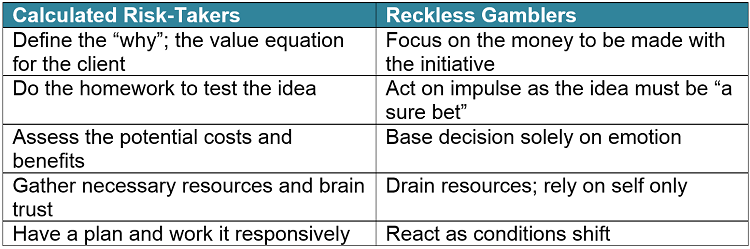
Indeed, in my coaching practice, I’ve observed 5 ways accomplished risk-takers differentiate themselves from gamblers:

risk_chart

But at the foundation of all of this is to have a lower level of fear than most people, or even an absence of fear. Because it is fear that keeps us from considering those decisions and actions that are outside of the box, and that will take our business and career from safe and small to extraordinary.

So we tell ourselves that people must just be born with a risk-taking quotient, and that it doesn’t run in our family. This is our excuse for removing ourselves from the equation. We then step back into our ordinary space, playing it safe and small, while others take the leaps and celebrate the rewards.

However, risk-taking isn’t a genetic trait – it’s acquired. You can, at any age, acquire the tools, skills, and knowledge to become a calculated risk-taker, and learn to avoid the pitfalls of those encountered by the reckless gambler.

So it’s back to confronting and overcoming the fear, because the approach to risk-taking can be learned. I’ll be writing about a specific method I use with clients to do this in my next article.

But meanwhile, what fear is holding you back from getting what you want?  And how do you move past it? Join us on LinkedIn to share, and for more discussion.

—

Patti Cotton helps women executives optimize their effectiveness in leading self, others, and enterprises. Her areas of focus include confidence, leadership style, executive presence, effective communication, and masterful execution. With over 25 years of leadership experience, both stateside and abroad, Patti works with individuals, teams, and organizations across industries, providing executive coaching, women’s leadership development, change, and conflict management. She is also a Fortune 500 speaker. For more information on how Patti Cotton can help you and your organization, click here.

Patti Cotton

Patti Cotton reenergizes talented leaders and their teams to achieve fulfillment and extraordinary results. For more information on how Patti Cotton can help you and your organization, click here.
Moving to the Front of the Leadership Pipeline

November 30, 2016 By Patti Cotton Leave a Comment

shutterstock_171066704a

3 Things You Need to Do Now

Are you thinking about moving into higher leadership? There’s some stiff competition out there.

Being seen and selected as “number 1” when it comes to moving up requires more than just being top talent. It requires that you shift how you think, act, and relate.

Many new executives and ascending leaders often think they will see what to do once they “get there.”  That’s a big mistake.

You can move to the front of the line quickly by mentally stepping into a leadership position before you get there.

Here are three of the most important steps to begin developing, today:

  1. Develop a wider lens. As you look at your area of responsibility, ask yourself how your area impacts not only other departments, but the organization and its vision. Begin connecting these dots and extend them outside the company to the industry, and to the marketplace. Starting to make wider and higher-level connections as you review your impact will develop your visionary “eye” and strategic thinking skills at new levels.
  2. Refine your decision-making and action-taking skills. When you make the move to more senior leadership, you’ll be moving away even more from the practice of your profession, and much closer to strategy, based on the information your team brings you. Ask yourself if you presently take too much time ruminating on decisions, or if you hesitate in taking action. And ask yourself if you trust your team – do you need to focus more on their development as you move forward? You will want to get in the habit of this with those who support you.
  3. Forge your leadership identity. Making sure that your leadership identity is strong and that it engenders trust and influence. Your distinct leadership “DNA” should be so distinctive that others can easily describe it in value-based terms. Forging this professional ascending will result in followership, leveraging the impact you are able to make.

Ready to go the front of the leadership pipeline? What’s your next move?  Join us on LinkedIn to share, and for more discussion.


Patti Cotton helps women executives optimize their effectiveness in leading self, others, and enterprises. Her areas of focus include confidence, leadership style, executive presence, effective communication, and masterful execution. With over 25 years of leadership experience, both stateside and abroad, Patti works with individuals, teams, and organizations across industries, providing executive coaching, women’s leadership development, change, and conflict management. She is also a Fortune 500 speaker. For more information on how Patti Cotton can help you and your organization, click here.

Patti Cotton

Patti Cotton reenergizes talented leaders and their teams to achieve fulfillment and extraordinary results. For more information on how Patti Cotton can help you and your organization, click here.

Fast-Tracking Your Way to the Top

November 23, 2016 By Patti Cotton Leave a Comment

shutterstock_161400572a

Do You Need a Mentor, Sponsor, or Coach?

You know you have what it takes to succeed, but you’d like to move a little faster to get to the top.

Getting help is the smart thing to do – but what kind of help do you need to get there?

Liz was in middle management, but she was bored with her area of responsibility and wanted more out of her career. She knew she was talented, but, although others always complimented her on her work, they didn’t seem to recognize she had more in her – at least, they didn’t say so. However, she was convinced she could contribute at higher levels, if just given the right opportunity. She also knew she could go a couple of directions in the company with her professional background and experience, and wondered which path was right for her.

One day, Liz shared all this with a couple of close colleagues.

“I’m ready for more – but no one has called me into the executive suite to say I’ve won the prize promotion. I know I can do this. How do I get the help I need to get there?”

“Get a mentor,” said Jackie. “Mentors are supposed to give you direction to help you get there, aren’t they? They can give you pointers on specific technical skills – I had one once that taught me how to better analyze financials, and that really helped the way I was able to strategize. Mentors can also put you in touch with other people in the industry to widen your networks and such. So they are a kind of career guide and connector. That has to be good for your career.”

“No, wait,” said John. “I’ve been reading about sponsors – some people call them champions. They are supposed to be better than mentors, aren’t they? If they decide you have more in you, they commit to positioning you with others in high places, and go around talking positively about you. They influence others to take a look at you, and they can volunteer you for projects that will show off what you can do. It’s kind of like the ultimate PR agent with clout.”

“Hey, I’m not sure either of you are right,” piped up Sandy. “My boss hired an executive coach who got her straight into the C-suite. They worked on the way she communicated so that she showed more confidence, instilled more trust – even sharpened her influence skills. And they worked on her decision-making, and how she led her team so that it went from mediocre- to high-performing. It really showcased her abilities.”

“Hmmm…,” said Liz. “It may be that I need all three. Let me reflect on this – stay tuned for an update, people!”

After careful thought, Liz sought out a well-known leader in the industry who happened to live in the area. She explained what she was doing, and that she needed some advice on her career path. This leader met with her, helped her to look at trends within her industry, and offered to connect her with people who could talk about career possibilities within her focus.

Liz then thought about seeking a sponsor. However, the sponsor relationship is usually initiated by the sponsor, and Liz knew she had to stand out before she asked for someone of influence to go to bat for her in the organization.

So she hired a coach. “You don’t know what you don’t know,” she thought. Her executive coach reviewed her career goals with her, and then suggested assessing how she led herself, others, and the enterprise (her area of responsibility). Together, they pinpointed some critical areas for improvement – ways of being, relating, and doing that would help her to showcase to others the exceptional talent she was. Liz and her coach worked over the next several months, and it paid off – someone higher up in the organization reached out to ask about her career goals, and to share they would like to help her get there.

Who’s in your court? And who needs to be?

For a free informational guide to help you determine your best resource for help based on where you are right now in your career, click here. 


Patti Cotton helps women executives optimize their effectiveness in leading self, others, and enterprises. Her areas of focus include confidence, leadership style, executive presence, effective communication, and masterful execution. With over 25 years of leadership experience, both stateside and abroad, Patti works with individuals, teams, and organizations across industries, providing executive coaching, women’s leadership development, change, and conflict management. She is also a Fortune 500 speaker. For more information on how Patti Cotton can help you and your organization, click here.

Patti Cotton

Patti Cotton reenergizes talented leaders and their teams to achieve fulfillment and extraordinary results. For more information on how Patti Cotton can help you and your organization, click here.

Why You Need Your Emotions for Rational Decision-Making

November 16, 2016 By Patti Cotton Leave a Comment

shutterstock_232649068a

We spend a lot of our lives learning to master emotions. Sometimes they overcome us, and we goof things up. So we try to discount them or put them aside in an effort to be more rational in our decisions and actions.

But discounting or ignoring emotions isn’t really mastering them. You need your emotions in order to make your best decisions. Sound counter-intuitive?

In my work with high-potential female executives, I find quite often that these women have shut off their emotions, feeling these get in their way. Often, they have been told they were being too emotional in a certain situation, or they have found themselves overwhelmed with feelings when confronting a critical scenario, and it kept them from moving forward. Somehow, these women decided to shut off the “feeling part” of themselves in order to execute and get ahead.

Bad move.

Emotions are meant to trigger or alert you to something. When you ignore these, negative consequences are in store, not only for yourself, but for the way you are able to work with others, and ultimately succeed.

So how do you manage your emotions so that they actually help you get ahead?

There are three steps to managing and bridging your feelings so you can support your best thinking and actions:

1. Recognize the emotion you are feeling in a situation.

This may sound easier than it is. I once coached Sandy, a member of her company’s C-Suite, who could only name two emotions that she felt – anger and fear. Because of this, she continuously operated from the “fight or flight” part of her brain – high stress, and low reasoning. As a result, her decision-making suffered. We spent a couple of months helping her to identify and expand her lexicon of emotions as I coached her on how to handle specific situations. Why? Emotions are “gut triggers.” It means, “Hey, something is up, here! Pay attention!” This allowed her to move from a “fight or flight” mode to the reasoning part of her brain.

2. Decide how you want to manage the emotion.

Recognizing what emotion you are experiencing in a certain situation allows you to ask yourself how you would like to handle it. Just because someone has angered you doesn’t mean you need to express your anger. It means, instead, that you can ask yourself why you are experiencing this, whether it comes from a bias or is relevant and appropriate to the situation, and what you want to do behaviorally because of your reflection. This process puts you in charge. Once Sandy could identify the emotion she was feeling in a certain situation, she was able to reason more effectively, asking herself what this emotion was telling her, and whether this was viably related to the decision or situation at hand.

3. Allow your emotional self to collaborate with your rational self.

When you have checked in with yourself as to why you are feeling a certain emotion, where it comes from, and how you want to handle the emotion, you have made space for your rational self to join at the table. Having recognized how you are feeling, what the emotion is telling you, and deciding how you want to handle the emotion, you can now ask yourself to identify the real issue at hand so that you can resolve it most effectively. Sandy discovered that a colleague had undermined her to her staff. When she stopped to recognize how she felt about this, how she wanted to manage it, she then felt much more in control of how she dealt with the situation. Instead of operating from her “hot buttons” as she would have done in the past, she was able to discuss the issue calmly with him, and worked to resolve things.

How do emotions affect the way you work? Join us for our LinkedIn discussion and share!


Patti Cotton helps women executives optimize their effectiveness in leading self, others, and enterprises. Her areas of focus include confidence, leadership style, executive presence, effective communication, and masterful execution. With over 25 years of leadership experience, both stateside and abroad, Patti works with individuals, teams, and organizations across industries, providing executive coaching, women’s leadership development, change, and conflict management. She is also a Fortune 500 speaker. For more information on how Patti Cotton can help you and your organization, click here.

Patti Cotton

Patti Cotton reenergizes talented leaders and their teams to achieve fulfillment and extraordinary results. For more information on how Patti Cotton can help you and your organization, click here.

  • « Go to Previous Page
  • Page 1
  • Interim pages omitted …
  • Page 35
  • Page 36
  • Page 37
  • Page 38
  • Page 39
  • Interim pages omitted …
  • Page 46
  • Go to Next Page »

Primary Sidebar

Patti Cotton
Tweets by @PattiCotton
  • About
  • Consulting
  • Training
  • Speaking
  • Blog
  • Contact
Home | Contact | Privacy Policy

© 2024 Cotton Group LLC | PATTI COTTON 360° LEADERSHIP®