• Skip to main content
  • Skip to primary sidebar

Patti Cotton

Executive Coach & Career Strategist

  • About
  • Consulting
  • Training
  • Speaking
  • Blog
  • Contact

support

What is so Important about Purpose at Work?

December 5, 2018 By Patti Cotton 1 Comment

What is so Important about Purpose at Work?
Image Credit: Shutterstock

Why talk about your purpose? Aren’t you too busy for such introspection?

When you are driving for results, it may seem odd to reflect on your purpose.

But purpose drives results. If you aren’t in touch with your purpose and the meaning of your contributions, you may be creating results right now, but you may lose the longer game.

And if you can’t help your employees see the value of their purpose as it relates to company results, you are losing out.

Here’s the long-game secret to staying engaged, performing well, hitting target goals – and helping others to do all this, as well:

Purpose + Motivation + Engagement = Results

These three things work together to help us move forward in life with joy and resolution. Together, they are what compel us to climb mountains, to learn foreign languages, and to work with commitment on those challenging new endeavors that require tenacity and perseverance.

You see, all humans seek meaning and purpose. We ask ourselves questions such as, “Why do I exist?” “Why am I here?” “How do I bring value to life, to the larger picture?”

Understanding the answers to these questions is a powerful driver. If we do not find our purpose in life, we lose interest in life. Purpose is what tells us the value of our unique self. It gives us a reason to be, a goal to work toward. If we can’t understand our reason for existing, we lose sight of our value as human beings.

If, on the other hand, we understand how we best contribute to a larger picture, how we bring value to life’s table, this allows us to recognize our worthiness as human beings.

When we have purpose, we live differently. Looking outside ourselves to a larger picture removes the tendency to center on ourselves. We a sense of well-being and contribution. Our dopamine rises to give us pleasurable feelings of energy and positivity. We have a reason to live.

In his epic work, Man’s Search for Meaning, Victor Frankl illustrates this. As he recounted his experiences in a World War II concentration camp, Frankl observed that those inmates who gave themselves a goal or recognized they had a purpose were much more likely to survive. Some held onto the vision of seeing their families in the future, and Frankl himself found purpose in reconstructing a manuscript he had written and lost on the way to the concentration camp. This purpose, these goals often meant the difference between the will to live – or not.

As you can see, purpose drives motivation.

What is your purpose?

Purpose compels us seek to achieve something with our contributions so that we can fulfill this purpose. We are stimulated to move forward, to target goals that will help us reach what we feel is our purpose – and as we see in Frankl’s illustration, is what gives us a reason to live, even in the most difficult of circumstances. We are motivated.

And motivation is what gives us the energy, drive and excitement to move forward in a certain direction or go after something we want to achieve. It’s the fire that fuels us and is necessary for us to steadily remind ourselves of who we are, our meaning and purpose.

But if purpose and motivation are what gives us meaning and energy, engagement is what keeps us going. Engagement compels us to persevere when times get challenging. We need engagement to truly reach the top of the mountain or to master that foreign language. One can be motivated to begin a new endeavor, but quickly abandon this when the going gets tough.

Think about a time when you set out to achieve something great and succeeded. What kept you going when you faced obstacles to your goal so that you remained engaged?

How can you use your experience with this to motivate and engage others so that they move forward with purpose? Here are four ways you can begin that are simple to implement with great returns:

  1. Be intentional about recognizing your team members as human beings.

We talk a lot about how to recognize and reward people for their good work, because this is key to motivating them. However, there are lots of resources out there on this, so I want to focus on a more basic, daily recognition of others as human beings. Begin the day and each interaction by eliminating feelings of anonymity. Check in by touching base personally before jumping into the task at hand. Remind them that you care about them as people by asking about their family, their weekend, or if they’ve been able to work on that hobby lately. We all get extremely busy, and sometimes, this can become a troublesome trend whereby people feel undervalued or not seen. Don’t let this become your culture.

  1. Find out what drives your team members.

Set a time when you can talk to your reports individually about their career aspirations and how you can best support them. Include an exploration about their strengths, what they feel they bring to the larger picture, and what drives them. They will feel recognized, supported, and energized. This also helps you to move them toward those projects, assignments and roles that most excite them – and will benefit the company most. It will aid you in knowing how to coach and mentor them, seeking those opportunities that align with their passion and interests.

  1. Connect work to a higher meaning.

When motivating and engaging others, it’s necessary to help them remember how their work connects with higher meaning. In order to do this, we need to understand how tasks and activities assigned to a role affect the larger picture. Let’s say, for instance, that some of your employees are in charge of customer service. The role requires problem-solving for customers all day long.

If your employees understand their contribution to the larger picture, this can keep them motivated and engaged when the going gets tough. Here’s how you help them make this connection: list the outcomes that come to mind when you have a satisfied customer.

I can think of the following: A happy customer = boosted company reputation, new business leads and referrals, more company profits, more jobs… This is one example of taking one’s tasks and responsibilities and connecting them to a higher meaning. When we understand our contribution to this larger picture, it reinforces our purpose, allowing us to recognize our value and worth.

  1. Give people more authority – not just responsibility.

People thrive on decision-making authority. It’s empowering and allows them to learn and grow, releases you to focus on other things, and brings fresh perspectives to the company. This means that you need to take more of a coaching and mentoring approach to your leadership. This helps you to leverage your people power and ability to achieve at the same time that you grow and develop others so that they can assume more responsibility.

Motivating and engaging yourself and others requires intentionality. It requires different conversations, but ones that are much more meaningful and rewarding. I challenge you to begin by incorporating one of the four steps above to see how it works for you.


HOW MUCH

DO OTHERS REALLY TRUST YOU?

​Learn the two vital parts to trust and how they can help you become a more highly effective leader.

GET THE INFOGRAPHIC

Patti Cotton

Patti Cotton reenergizes talented leaders and their teams to achieve fulfillment and extraordinary results. For more information on how Patti Cotton can help you and your organization, click here.

100 Best Performing CEOs: How Do You Measure Up?

November 21, 2018 By Patti Cotton Leave a Comment

100 Best Performing CEOs: How Do You Measure Up?
Image Credit: Shutterstock

The Harvard Business Review (HBR) has just come out with its annual list of 100 best performing CEOs in the world.

Who are these leaders and what makes them different?

The team at HBR uses tough criteria to identify and rank these CEOs, assessing their capability to lead in a volatile world.

How do you measure such capability?

Outcomes.

Quite a bit of HBR’s process involves reviewing the profitability and forward movement of the company, seeing how well it sustains momentum in the midst of challenging outside forces – “savvy competitors, demanding customers, profit-hungry investors, political and economic headwinds” (Best Performing CEOs in the World 2018).

How would you measure up?

Is it fair to judge you as leader when external forces aren’t in your control?

Yes and no.

You certainly cannot change or control external forces.

But you can change the way you meet them.

And this is exactly how these 100 best performing CEOs became part of HBR’s list.

Of course, vision, strategy, and focused action all played into successful outcomes. But what makes the difference for winners once the plans are in place are two things: steadiness and stability.

That’s right – steadiness and stability.

Sound dull? These are two of the most underrated traits in leadership – and yet, two of the most important.

Steadiness is the ability to continue pushing through even at the toughest times so that you can emerge from the toughest of maelstroms. And stability is a foundational strength that provides focus, security and safety.

It stands to reason that, unless you can lead with steadiness and stability, you will compromise your targeted success.

I recall a time in my younger years when my then 35-year-old father left his teaching position to develop healthcare facilities. His vision and strategy were sound, and against all odds, he first developed a retirement center, a convalescent and rehab center, and a hospital all within three years. The city sorely needed these facilities – even the hospital which was just a mile from a larger more established one. The administrator of the latter had shared with Dad that they needed overflow facilities and if Dad would develop a community hospital, there were patients waiting.

So Dad began developing these with a passion and determination that were unparalleled. But he met with great resistance. Someone in town complained that if another hospital was built, that his dog would be nervous. Someone else tried to get in front of Dad and quickly develop a hospital before he did, even after Dad had procured the licenses and permissions necessary to break ground. There were fights and opposition all around. And 16 City Council hearings. Sixteen.

I reflect on that and ask how many people would have weathered all this at 35 years old. In the end, he won – and so did the town, which has benefited from these facilities for several decades, now.

But Dad could not have done this without unwavering steadiness – the commitment to push through even when incredibly discouraged and feeling alone. He could not have done this without the stability that his vision gave him – the strength and commitment to move with focus.

How would you rank your steadiness? And your stability in the face of opposing winds?

Here is my personal challenge to you for growth:

  • During this upcoming holiday season, I invite you to reflect on those times when you have faced difficulty, but still pushed through to successful outcomes. Celebrate this!
     
  • Ask yourself where there is room for more steadiness in your leadership…more stability. What stretch goals do you have for yourself, your team, for the company – and how will these traits play into reaching them?
     

Are you interested in developing greater leadership capacity in your work and life?

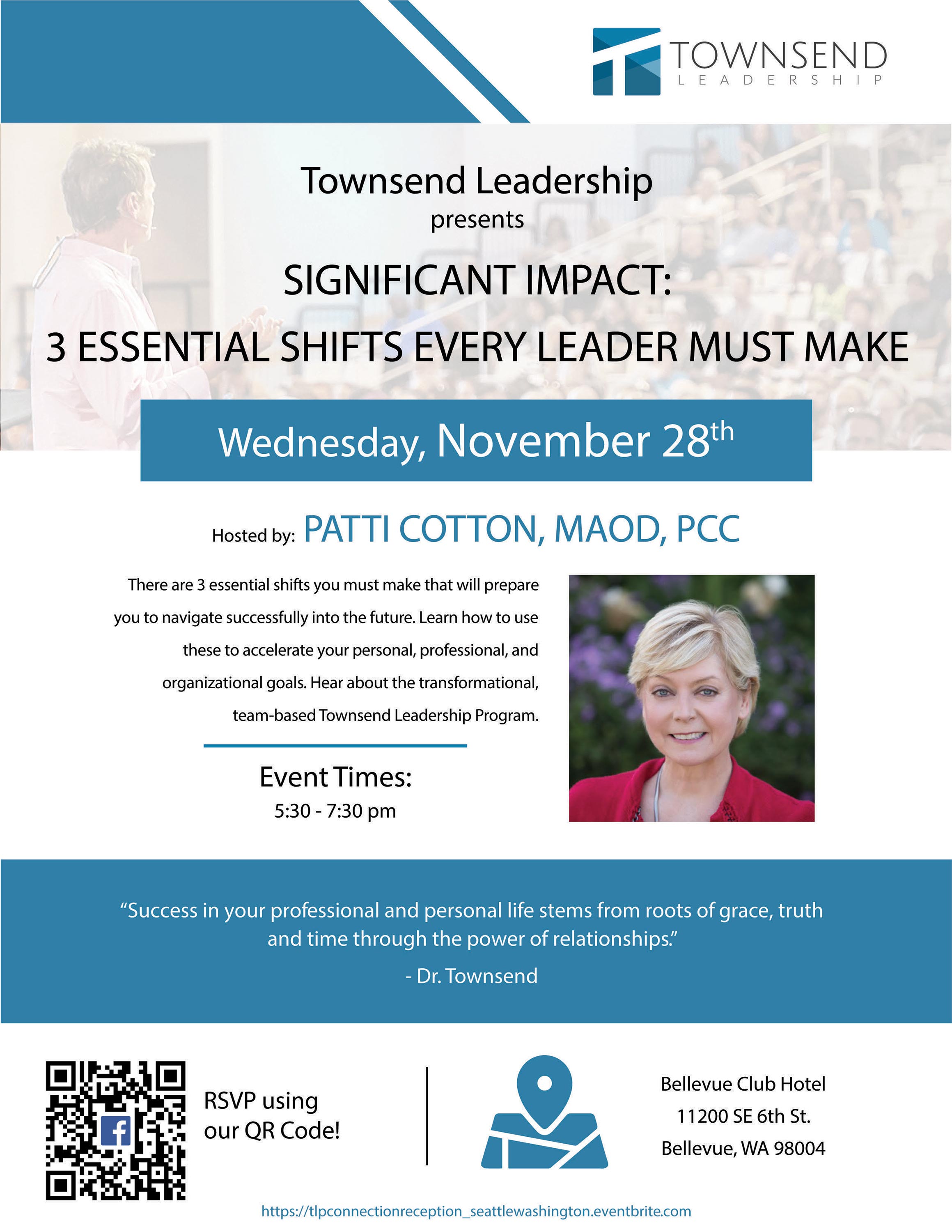
Come and join me at the Bellevue Club Hotel in the Seattle area on November 28 to hear more about how you can do so. Seating is limited and folks are flying in to attend, so please rsvp only if you are sure you can be there: https://www.eventbrite.com/e/3-essential-shifts-every-leader-must-make-tickets-51973207262.

Or for Southern California leaders, e-mail me at patti@patticotton.com for details of a private upcoming event in the Inland Empire.

Townsend Leadership

Patti Cotton

Patti Cotton reenergizes talented leaders and their teams to achieve fulfillment and extraordinary results. For more information on how Patti Cotton can help you and your organization, click here.
3 Essential Shifts Every Leader Must Make – Part 3

November 14, 2018 By Patti Cotton Leave a Comment

3 Essential Shifts Every Leader Must Make Part 3: Leadership and Brain Trust
Image Credit: Shutterstock

Leadership and Brain Trust

How well prepared are you to lead into the future?

The world now requires that you lead at a higher level to navigate change and complexity.

It demands that you have a greater capacity for the kinds of decisions and challenges that confront you now and in the future.

This requires a powerful three-pronged approach to support your leadership.

Over the last two articles, we talked about two of these elements, and they are:

  • Sharpening your emotional intelligence skills to increase your relational skills, your ability to influence and to impact
  • Up-leveling your leadership character to fuel your skills and potential

Without these two abilities, you as leader may be close to your expiry date.

This week, we’ll talk about the third and final element to developing your leadership capacity: brain trust.

What is brain trust, and why do you need it?

The term “brain trust” is a term that was first coined by James Kieran, a New York Times reporter. He used this term to describe the group of leaders assembled by Franklin Delano Roosevelt during his presidential administration. President Franklin brought these “brains” together to advise him, decode problems, and design new solutions for America.

It is critical that a leader has a brain trust for several reasons. Here are the top five:

  • Perspective

Because leading requires complex decision-making, being able to see and understand a problem or challenge from all angles is necessary.

Albert Einstein’s quote reminds us that you can’t solve these with the same mindset that created them. However, it is often difficult to step outside oneself to see these additional angles. Having a brain trust made up of people who come from various industries and backgrounds means you can tap into a vast pool of experience for greater perspective and creative solutions.

President Roosevelt’s brain trust helped him to enact 19 laws to meet America’s challenges in just the first 100 days of him being in office. He freely admitted this was due to having an intellectual powerhouse to bring ideas and perspective that he could not bring to the table alone.

  • Powerful Support

It gets lonely when you carry big responsibilities. You balance many demands and set the standard for your organization.

Carrying all this alone can cause isolation and stress, as you feel you must face and meet these challenges by yourself. In fact, a recent survey shows that 60% of all leaders express feelings of isolation and they report that this hinders their performance.

Unburdening and processing with family, friends, or direct reports often creates greater stress on these relationships and can’t provide the right kind of support the leader needs to meet life and work effectively.

It is important for you as leader to have a safe and powerful support system that is trustworthy, confidential, and one that can receive and help process the complexity of your challenges.

  • Challenge

If you want to continue to grow so that you lead both your life and work solidly into the future, you need input.

What are you not seeing that you need to examine?

How is not leading at a higher level affecting your life and work?

With great responsibilities, you can operate from “stress mode” as you address the immediate and urgent. This can develop tunnel vision, and you will lean on familiar approaches that cannot meet more complex problems. This dynamic will keep you from being able to solve these, and to meet the important goals that will truly make a difference for you and the others around you.

A brain trust will challenge you where you might be playing small with limited thinking or approaches. It will provide that safe space for you to confront where you are holding yourself back and decide how you want to move forward.

  • Accountability

Change is hard; growth is hard. Without an accountability mechanism, the biggest goals and commitments are seldom met successfully.

As you process and make the decisions you need in order to move forward in both your life and work, a brain trust will keep you accountable to yourself and your commitments. And because a brain trust’s only agenda is your agenda, you can count on your brain trust as an unbiased and supportive group that has your best interests in mind.

This will help you to stay on track and to focus where you need in order to meet goals.

  • Community

How edifying and uplifting is your community?

If you are like most, you have little time to enjoy the nurturing benefits of connection and community. In fact, your responsibilities and pace as leader can limit your ability to form meaningful community and to enjoy the gifts and benefits of bonds and belonging.

Sadly, if you are like most leaders, your community feels fragmented and might be made up of some or all of these:

  • Frantic seasonal socializing to reconnect with old friends during holidays
  • Networking and brainstorming with peers
  • Industry or business-specific meetings with colleagues
  • Connections with families of your children and grandchildren during sports season
  • A weekly (if even that!) church experience

An intentionally-focused community that encourages intellectual improvement, supports personal and professional growth, and genuinely cares about you is an invaluable and rejuvenating asset to the leader. What’s more, being able to connect with this kind of community in time of crisis or celebration is priceless.

“When we live our lives in isolation, what we have is unavailable, and what we lack is unprocurable,” wrote Basil.

It is time to admit that going it alone doesn’t work anymore.

As you seek to meet the challenges of the future more effectively, having a solid brain trust is a not a “nice to have,” but a necessary component to your life and work.


© Patti Cotton and patticotton.com. All rights reserved. Unauthorized use and/or duplication of this material without express written permission from the author is strictly prohibited. Excerpts and links may be used, provided that attribution is made to Patti Cotton and patticotton.com, with links thereto.

Patti Cotton

Patti Cotton reenergizes talented leaders and their teams to achieve fulfillment and extraordinary results. For more information on how Patti Cotton can help you and your organization, click here.

Holding Others Accountable

October 10, 2018 By Patti Cotton Leave a Comment

Holding Others Accountable
Image Credit: Shutterstock

Is it easy for you to hold others accountable? Even the most seasoned leaders can find this difficult.

Yet, accountability is the very thing that makes everything work.

Holding others accountable was indeed challenging for Randy, CEO of Andes, Inc., and this meant that the company wasn’t getting the results it needed. What’s more, Andes had begun to lose market share. Would it survive?

Randy was missing just one ingredient in order to turn things around.

Accountability.

Randy had brought in a bevy of consultants to review the company’s challenges. His drawer was full of strategic plans, and employees had undergone training in a number of programs meant to help them work better, smarter, and get greater results. Yet, nothing had worked. Meanwhile, it was discovered that some teams were duplicating efforts, and others weren’t delivering on what was expected. Randy was frustrated, and sometimes lost his temper, wondering why people weren’t just doing what they should do.

The fact was, he simply wasn’t holding his team accountable. And in turn, they weren’t holding their own teams accountable, either.

Things were a mess.

Holding others accountable is what is necessary to helping others to deliver on their commitment so that the work gets done. If you are responsible for organizational or team outcomes, it’s necessary to learn how to do this well so that you get the results you need. Holding others accountable is also a way of saying, “Your contributions matter,” which motivates employees and helps them to be more engaged.

Holding others accountable, however, can feel awkward.

And that’s what Randy felt. He was great at inspiring and motivating others but helping them to follow through was where he fell short. He thought that providing clear feedback felt like criticism, and so he avoided giving others the feedback they needed in order to know they were on track. Left to their own devices, the executive team simply interpreted what they thought should be done, did the best they could, but failed miserably because of a lack of information. They passed on this unfortunate culture of murky mediocrity to the rest of the organization – and this is why it started to fail.

Fortunately, with coaching, Randy turned things around. He met with his team, agreed on what was needed, and shared the 5 steps to hold others accountable. Over time, Andes moved into a position of excellence.

If you feel you need to strengthen your accountability game, use these 5 steps to put in place a system that works:

1. Be clear about your expectations.

In order for others to be able to deliver on your expectations, they need to understand what these are. Be sure that as you share what you expect that you ask them if they have questions and let them know that they will have access to you for questions as they move forward.

2. Help identify the skills and resources needed to support them.

What will they need in order to perform well? Who are the people they need to work with, and what are politics, protocols, and processes of which they need to be aware in order to succeed?

3. Follow up regularly.

Agree on the way in which your reports will keep you updated on their progress. Do you want them to meet with you regularly to report to you, or provide a written report? How often? What elements do you need to see in the report?

4. Give clear and timely feedback.

Honest and ongoing feedback is critical to the process. Be sure you are timely so that this becomes a powerful mentoring experience. And be clear in your feedback. If you are not, you should not expect to see the progress you expect.

5. Clear consequences.

Have you made sure you have done everything you can to help the person succeed in performance?  If they have succeeded, reward this in a way that is appropriate to the outcome such as acknowledgment, recognition, or even a bonus or promotion. If there has been a lack of clarity on your part, be sure you course-correct this by repeating the steps above. And if the person shows signs of inability or commitment to perform, then it’s time to release them from the assignment or role with any other appropriate steps needed.

I challenge you to make accountability a chief focus for the coming season. Your leadership will be even more effective, and your results will help the organization to thrive.


HOW MUCH

DO OTHERS REALLY TRUST YOU?

​Learn the two vital parts to trust and how they can help you become a more highly effective leader.

GET THE INFOGRAPHIC

Patti Cotton

Patti Cotton reenergizes talented leaders and their teams to achieve fulfillment and extraordinary results. For more information on how Patti Cotton can help you and your organization, click here.

When Servant Leadership Doesn’t Work

October 3, 2018 By Patti Cotton Leave a Comment

When Servant Leadership Doesn’t Work
Image Credit: Shutterstock

It is said that servant leaders – those who truly lead from the heart – are the most effective.  

Indeed, inspiring and influencing others to rise to their personal and collective best yields much greater results. And frankly, this makes a significant impact in the lives of those who are part of this, as well as those clients who benefit.  

But there are situations when such leadership does not work. 

How can you tell whether to adopt this style or not?

First, servant leadership is a philosophy that genuinely puts people first, takes a keen interest in their development, and embraces shared power rather than a hierarchical style.  

In fact, leading from the heart – another way to describe servant leadership at its finest – requires embracing and modeling 7 traits: 

  1. Trust  
  2. Authenticity 
  3. Empathy 
  4. Compassion 
  5. Humility 
  6. Courage 
  7. Motivation  

The problem is, when leaders don’t incorporate all 7 traits, the power of leading from the heart is compromised. 

The question becomes, “Are you willing to work on adopting all 7 traits?”

Ask yourself the following: 

  • Trust – do my directives and communication reflect integrity? Are these consistent, and if not, am I willing to course-correct this with others so that I build trust with them? 
  • Authenticity – do I come from “center” with ease, not trying to emulate the style or persona of others?  
  • Empathy – can I easily detect the emotions of others, place myself in their shoes, and affirm them? 
  • Compassion – do my decisions and actions reflect that I put people first? 
  • Humility – do I respect others as much as I do myself, and can I recognize their gifts and talents as much as my own? Do I realize that without my team and the employee base that we could not accomplish what we do? 
  • Courage – am I willing to confront the tough stuff, even when the topic and decisions I may need to make are not popular ones? 
  • Motivation – am I motivated first by what is best for the organization, or am I preoccupied with what is best for me? 

If you are willing to sharpen these 7 traits, you will find that your team and culture will reflect greater satisfaction, higher engagement, and the innovative spark to help you and the organization meet the future. 

Which of these traits is most important for you to work on as you begin to up-level your leadership?


HOW MUCH

DO OTHERS REALLY TRUST YOU?

​Learn the two vital parts to trust and how they can help you become a more highly effective leader.

GET THE INFOGRAPHIC

Patti Cotton

Patti Cotton reenergizes talented leaders and their teams to achieve fulfillment and extraordinary results. For more information on how Patti Cotton can help you and your organization, click here.

  • « Go to Previous Page
  • Page 1
  • Interim pages omitted …
  • Page 7
  • Page 8
  • Page 9
  • Page 10
  • Page 11
  • Interim pages omitted …
  • Page 20
  • Go to Next Page »

Primary Sidebar

Patti Cotton
Tweets by @PattiCotton
  • About
  • Consulting
  • Training
  • Speaking
  • Blog
  • Contact
Home | Contact | Privacy Policy

© 2024 Cotton Group LLC | PATTI COTTON 360° LEADERSHIP®