• Skip to main content
  • Skip to primary sidebar

Patti Cotton

Executive Coach & Career Strategist

  • About
  • Consulting
  • Training
  • Speaking
  • Blog
  • Contact

identify

100 Best Performing CEOs: How Do You Measure Up?

November 21, 2018 By Patti Cotton Leave a Comment

100 Best Performing CEOs: How Do You Measure Up?
Image Credit: Shutterstock

The Harvard Business Review (HBR) has just come out with its annual list of 100 best performing CEOs in the world.

Who are these leaders and what makes them different?

The team at HBR uses tough criteria to identify and rank these CEOs, assessing their capability to lead in a volatile world.

How do you measure such capability?

Outcomes.

Quite a bit of HBR’s process involves reviewing the profitability and forward movement of the company, seeing how well it sustains momentum in the midst of challenging outside forces – “savvy competitors, demanding customers, profit-hungry investors, political and economic headwinds” (Best Performing CEOs in the World 2018).

How would you measure up?

Is it fair to judge you as leader when external forces aren’t in your control?

Yes and no.

You certainly cannot change or control external forces.

But you can change the way you meet them.

And this is exactly how these 100 best performing CEOs became part of HBR’s list.

Of course, vision, strategy, and focused action all played into successful outcomes. But what makes the difference for winners once the plans are in place are two things: steadiness and stability.

That’s right – steadiness and stability.

Sound dull? These are two of the most underrated traits in leadership – and yet, two of the most important.

Steadiness is the ability to continue pushing through even at the toughest times so that you can emerge from the toughest of maelstroms. And stability is a foundational strength that provides focus, security and safety.

It stands to reason that, unless you can lead with steadiness and stability, you will compromise your targeted success.

I recall a time in my younger years when my then 35-year-old father left his teaching position to develop healthcare facilities. His vision and strategy were sound, and against all odds, he first developed a retirement center, a convalescent and rehab center, and a hospital all within three years. The city sorely needed these facilities – even the hospital which was just a mile from a larger more established one. The administrator of the latter had shared with Dad that they needed overflow facilities and if Dad would develop a community hospital, there were patients waiting.

So Dad began developing these with a passion and determination that were unparalleled. But he met with great resistance. Someone in town complained that if another hospital was built, that his dog would be nervous. Someone else tried to get in front of Dad and quickly develop a hospital before he did, even after Dad had procured the licenses and permissions necessary to break ground. There were fights and opposition all around. And 16 City Council hearings. Sixteen.

I reflect on that and ask how many people would have weathered all this at 35 years old. In the end, he won – and so did the town, which has benefited from these facilities for several decades, now.

But Dad could not have done this without unwavering steadiness – the commitment to push through even when incredibly discouraged and feeling alone. He could not have done this without the stability that his vision gave him – the strength and commitment to move with focus.

How would you rank your steadiness? And your stability in the face of opposing winds?

Here is my personal challenge to you for growth:

  • During this upcoming holiday season, I invite you to reflect on those times when you have faced difficulty, but still pushed through to successful outcomes. Celebrate this!
     
  • Ask yourself where there is room for more steadiness in your leadership…more stability. What stretch goals do you have for yourself, your team, for the company – and how will these traits play into reaching them?
     

Are you interested in developing greater leadership capacity in your work and life?

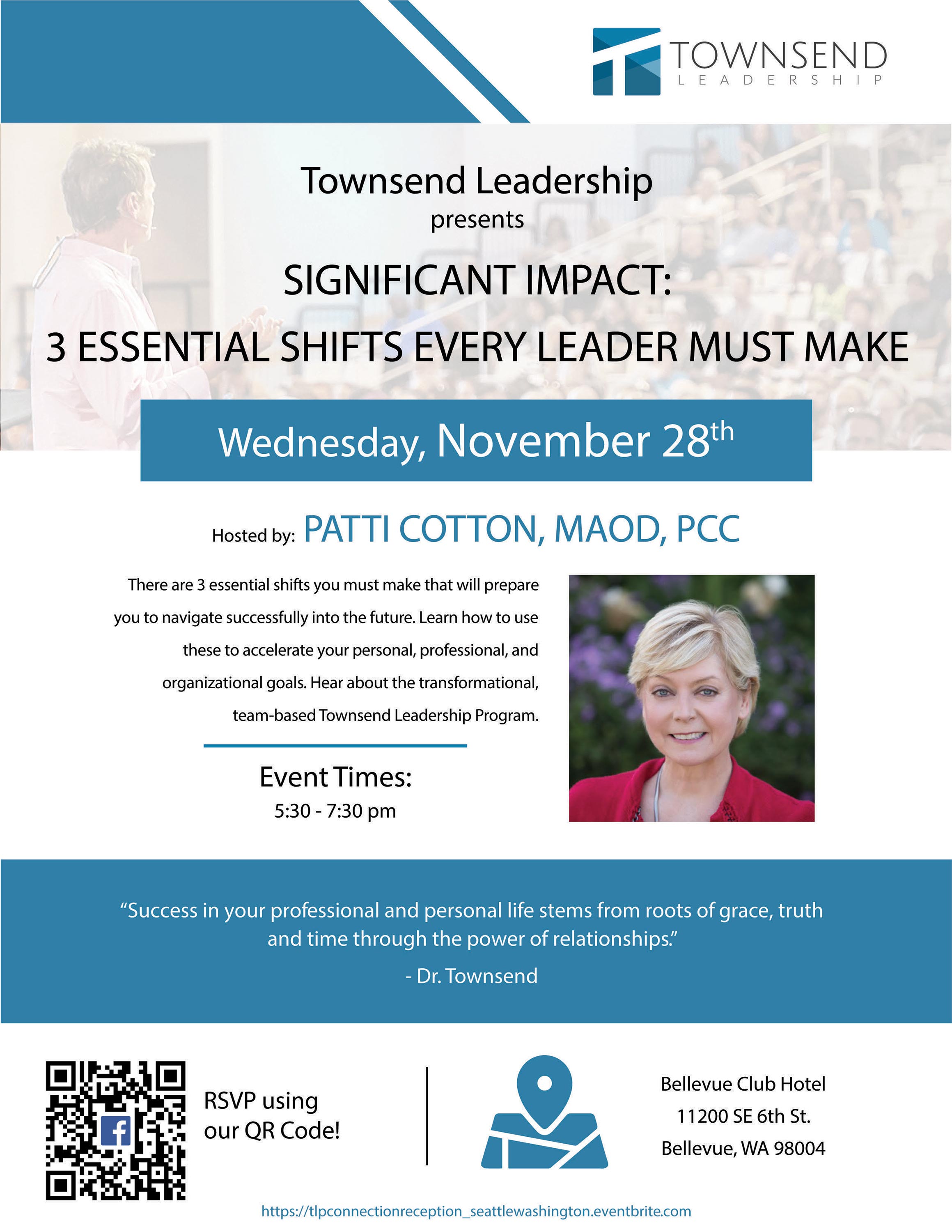
Come and join me at the Bellevue Club Hotel in the Seattle area on November 28 to hear more about how you can do so. Seating is limited and folks are flying in to attend, so please rsvp only if you are sure you can be there: https://www.eventbrite.com/e/3-essential-shifts-every-leader-must-make-tickets-51973207262.

Or for Southern California leaders, e-mail me at patti@patticotton.com for details of a private upcoming event in the Inland Empire.
Townsend Leadership

Patti Cotton

Patti Cotton reenergizes talented leaders and their teams to achieve fulfillment and extraordinary results. For more information on how Patti Cotton can help you and your organization, click here.

3 Essential Shifts Every Leader Must Make – Part 3

November 14, 2018 By Patti Cotton Leave a Comment

3 Essential Shifts Every Leader Must Make Part 3: Leadership and Brain Trust
Image Credit: Shutterstock

Leadership and Brain Trust

How well prepared are you to lead into the future?

The world now requires that you lead at a higher level to navigate change and complexity.

It demands that you have a greater capacity for the kinds of decisions and challenges that confront you now and in the future.

This requires a powerful three-pronged approach to support your leadership.

Over the last two articles, we talked about two of these elements, and they are:

  • Sharpening your emotional intelligence skills to increase your relational skills, your ability to influence and to impact
  • Up-leveling your leadership character to fuel your skills and potential

Without these two abilities, you as leader may be close to your expiry date.

This week, we’ll talk about the third and final element to developing your leadership capacity: brain trust.

What is brain trust, and why do you need it?

The term “brain trust” is a term that was first coined by James Kieran, a New York Times reporter. He used this term to describe the group of leaders assembled by Franklin Delano Roosevelt during his presidential administration. President Franklin brought these “brains” together to advise him, decode problems, and design new solutions for America.

It is critical that a leader has a brain trust for several reasons. Here are the top five:

  • Perspective

Because leading requires complex decision-making, being able to see and understand a problem or challenge from all angles is necessary.

Albert Einstein’s quote reminds us that you can’t solve these with the same mindset that created them. However, it is often difficult to step outside oneself to see these additional angles. Having a brain trust made up of people who come from various industries and backgrounds means you can tap into a vast pool of experience for greater perspective and creative solutions.

President Roosevelt’s brain trust helped him to enact 19 laws to meet America’s challenges in just the first 100 days of him being in office. He freely admitted this was due to having an intellectual powerhouse to bring ideas and perspective that he could not bring to the table alone.

  • Powerful Support

It gets lonely when you carry big responsibilities. You balance many demands and set the standard for your organization.

Carrying all this alone can cause isolation and stress, as you feel you must face and meet these challenges by yourself. In fact, a recent survey shows that 60% of all leaders express feelings of isolation and they report that this hinders their performance.

Unburdening and processing with family, friends, or direct reports often creates greater stress on these relationships and can’t provide the right kind of support the leader needs to meet life and work effectively.

It is important for you as leader to have a safe and powerful support system that is trustworthy, confidential, and one that can receive and help process the complexity of your challenges.

  • Challenge

If you want to continue to grow so that you lead both your life and work solidly into the future, you need input.

What are you not seeing that you need to examine?

How is not leading at a higher level affecting your life and work?

With great responsibilities, you can operate from “stress mode” as you address the immediate and urgent. This can develop tunnel vision, and you will lean on familiar approaches that cannot meet more complex problems. This dynamic will keep you from being able to solve these, and to meet the important goals that will truly make a difference for you and the others around you.

A brain trust will challenge you where you might be playing small with limited thinking or approaches. It will provide that safe space for you to confront where you are holding yourself back and decide how you want to move forward.

  • Accountability

Change is hard; growth is hard. Without an accountability mechanism, the biggest goals and commitments are seldom met successfully.

As you process and make the decisions you need in order to move forward in both your life and work, a brain trust will keep you accountable to yourself and your commitments. And because a brain trust’s only agenda is your agenda, you can count on your brain trust as an unbiased and supportive group that has your best interests in mind.

This will help you to stay on track and to focus where you need in order to meet goals.

  • Community

How edifying and uplifting is your community?

If you are like most, you have little time to enjoy the nurturing benefits of connection and community. In fact, your responsibilities and pace as leader can limit your ability to form meaningful community and to enjoy the gifts and benefits of bonds and belonging.

Sadly, if you are like most leaders, your community feels fragmented and might be made up of some or all of these:

  • Frantic seasonal socializing to reconnect with old friends during holidays
  • Networking and brainstorming with peers
  • Industry or business-specific meetings with colleagues
  • Connections with families of your children and grandchildren during sports season
  • A weekly (if even that!) church experience

An intentionally-focused community that encourages intellectual improvement, supports personal and professional growth, and genuinely cares about you is an invaluable and rejuvenating asset to the leader. What’s more, being able to connect with this kind of community in time of crisis or celebration is priceless.

“When we live our lives in isolation, what we have is unavailable, and what we lack is unprocurable,” wrote Basil.

It is time to admit that going it alone doesn’t work anymore.

As you seek to meet the challenges of the future more effectively, having a solid brain trust is a not a “nice to have,” but a necessary component to your life and work.


© Patti Cotton and patticotton.com. All rights reserved. Unauthorized use and/or duplication of this material without express written permission from the author is strictly prohibited. Excerpts and links may be used, provided that attribution is made to Patti Cotton and patticotton.com, with links thereto.

Patti Cotton

Patti Cotton reenergizes talented leaders and their teams to achieve fulfillment and extraordinary results. For more information on how Patti Cotton can help you and your organization, click here.

Man or Machine: Who Will Win in the Workplace of the Future?

July 11, 2018 By Patti Cotton Leave a Comment

Man or Machine: Who Will Win in the Workplace of the Future?
Image Credit: Shutterstock

What’s smarter than a human being?

A group of human beings.

Putting our heads together to come up with brilliant ideas and implementation has been recognized for centuries as “brain-trusting,” and is well-known for the rich perspectives, problem-solving, and creativity it can generate.

But now that machines loom larger and smarter, will this mean that we lose brain trust to brawn?

The experts project a loss of 800 million jobs by 2030 to machines.

How will you remain viable and vibrant in the new age of artificial intelligence (AI)?

AI is currently viewed as both an exciting development and a terrible threat. The advances we are able to make today and tomorrow are critical to meet an ever-growing complex world. Yet, we also realize that what has previously been accomplished by humans can now be taken over, at least in part, by machines.

What does that mean for meaningful work for us and for those generations that succeed us?

Will we lose our workplace to the machine?

No.

In fact, work may become more meaningful than ever before – if you and your organization are prepared to meet it.

It is important to understand that we continue to design machines that can take over automated tasks and mundane, repetitive work. We are seeing this in the operation and support of factories and production lines, customer call operations, document classification, and other areas.

With this development, machines will indeed replace a large part of the workforce that has previously performed these tasks.

In addition, machines are now capable of performing other more complex activities such as those requiring the processing of data streams, real-time knowledge, etc. Again, machines will dominate in this particular arena.

Then what is left for us?

How can AI actually benefit and bring more meaningful work opportunities to the human part of the future workforce?

Here are three ways:

1. Opportunities for vertical development.

Instead of emphasizing hard skills and competencies, focus will be on vertical development: developing the ability to perform more complex and adaptive thinking and to “see” with a greater lens and make sense of a world growing in complexity.

Our charge will be oversight and management of machines, rather than performing the tasks.

Abilities required of us at greater levels will be adaptability, network thinking, judgment, and creativity. Acquiring these skills means more career opportunities and greater flexibility in work choices open to us.

The good news is that each of us has been given the seeds to develop vertically – and there are proven ways to develop it systematically.

2. Opportunities to support the need for belonging and growth.

Human beings seek to belong, and they seek growth.

The workplace plays a critical role in helping people to do this. Those organizations embodying a culture of collaboration and offering individual and group growth opportunities will support these needs.

Further, this will benefit the company by lowering employee turnover, and heightening engagement, satisfaction, and productivity. Machines cannot create and support this culture – it is the people alone who are empowered to do this.

What does your company need in order to support this need for belonging and growth?

3. Opportunities to tap into collective intelligence (CI) to become the organization of the future.

CI is shared or group intelligence that emerges from the collaboration and collective efforts of many. And it is key to moving an organization into the future.

Gone is the hierarchical business model of one “general” at the top, several “sergeants” at the next levels, and many “foot soldiers” carrying out the tasks.

Instead, teams are leading teams, from top to bottom – to sideways. As leaders now demand greater leadership at every level, their workforces demand to have more voice and participation in leading the company forward.

We recognize the power of this collective, and welcome the rich brain trust it provides.

As we incorporate greater vertical development, a sense of belonging, and collective intelligence, this means we will have the ability to operate at a higher level of intelligence and meaning than we have ever experienced. And that is pretty exciting!

So where do we go from here? What’s your burning question or concern about man and machine in the workplace?


HOW MUCH

DO OTHERS REALLY TRUST YOU?

​Learn the two vital parts to trust and how they can help you become a more highly effective leader.

GET THE INFOGRAPHIC

Patti Cotton

Patti Cotton reenergizes talented leaders and their teams to achieve fulfillment and extraordinary results. For more information on how Patti Cotton can help you and your organization, click here.

Three Ways Compassion Makes Your Business Better

June 20, 2018 By Patti Cotton Leave a Comment

Three Ways Compassion Makes Your Business Better
Image Credit: Shutterstock

In a recent CBS This Morning interview, Jeff Weiner, CEO of LinkedIn, expressed the importance of compassion in the workplace.

Regarding the organization of the future, Jeff said, “It’s about walking the walk… It’s about looking at different perspectives…it’s about those interpersonal or soft skills…that will set yourself, your team, and the organization up for success.”

To some people, this may sound like fluff.

After all, what’s love got to do with it?

How do you link compassion with success in a way that makes business sense?

First, let’s define what compassion is – and what it isn’t. A short definition of compassion is to have concern for the well-being of others. For more on this – and to learn what it isn’t – see my article on compassion and boundaries.

How does having concern for the well-being of others increase the bottom line?

Here are three ways compassion directly impacts your revenues.

1. Communication.

When compassion is absent from communication, it reflects a lack of willingness to walk in the other person’s shoes.

It is evidenced by little or no interest in hearing the perspectives of others, or in seeking to understand. It is also evidenced by a heightened tendency for reactive and judgmental thinking.

Poor communication can actually cost your company an average of $26,041 in productivity per employee per year. It can cost your managers the ability to perform the work and manage others; and it can cost you your leadership reputation.

2. Team and organizational alignment.

When compassion is absent from a company, teams and team members within teams work in silos.

Silos are responsible for missed deadlines, arguments over who is responsible for what, distrust, poor assumptions about others, conflict – the list goes on. The energy in such a business is negative and draining to the soul, and productivity is low as a result of it.

Do you consider yourself a compassionate leader? Be careful. Hubris Syndrome can creep up quickly, and you may discover you have actually compromised your leadership. For more on this, see my article: “Can You Lead with Heart and Get Results?”

3. Competitive advantage.

Caring for others gives you a corporate edge. But when compassion is absent, it has been proven to compromise your employees’ feelings of safety and loyalty.

They doubt that learning, collaboration, and innovation are possible at your company and can shut down, which impacts the bottom line. Service quality suffers without compassion, and the employee’s desire to empathize with others and move beyond personal bias to form a team suffers as well.

It is time to identify and take action on strategies for the workplace that ignite compassion, because, as you see, love and results do, indeed, go hand in hand.

Inspired by the book, Awakening Compassion at Work: The Quiet Power that Elevates People and Organizations (Berrett-Koehler Publishers, 2017, 272 pages)


HOW MUCH

DO OTHERS REALLY TRUST YOU?

​Learn the two vital parts to trust and how they can help you become a more highly effective leader.

GET THE INFOGRAPHIC

Patti Cotton

Patti Cotton reenergizes talented leaders and their teams to achieve fulfillment and extraordinary results. For more information on how Patti Cotton can help you and your organization, click here.

Has Your Leadership Expired?

June 13, 2018 By Patti Cotton Leave a Comment

Has Your Leadership Expired?
Image Credit: Shutterstock

There is much buzz about “the organization of the future” as the top business focus around the globe. Indeed, in a world-wide survey conducted by Deloitte Touche Tohmatsu Ltd, the focus takes first place among 11 other key issues facing executives today as they ask themselves how to keep their respective companies sustainable into the next generation and beyond.

This makes sense. What leader doesn’t want his or her company to move into the future successfully? Those leading realize that, as technology and shifting customer demands transform the business landscape, they will need to restructure the organization, including many processes, roles and responsibilities, and other moving parts in order to deliver services and products.

But leadership needs to change, too.

In order to lead the organization of the future, to support required new approaches, ways of thinking, doing, workforce shifts, and so much more, leaders will need to up their game.

Is your leadership up to it?

Or is it out of date?

Top tenets of the organization of the future include operating at a faster pace, adapting more quickly to market demands, acquiring new knowledge more rapidly, and embracing dynamic career demands.

What will the leaders of today need to do in order to prepare for this?

The answer lies beyond a traditional emphasis on horizontal development, which concentrates on acquiring additional information, skills and competencies.

Instead, leaders will also need to add a focus on their vertical development – developing more complex and sophisticated ways of thinking.

This only makes sense: a more complex world mean that the organization needs to respond in kind.

To do this, we need a more sophisticated way of seeing and making sense of things so that we can lead effectively.

Here are some highlights of vertical development. Do you reflect these in your leadership?

  • Strategic Thinking 2.0

Your strategic thinking sees many patterns and connections. Gone is the black and white thinking of the past. It’s time to become comfortable with uncertainty as the norm instead of having a high need for certainty.

  • Leading Change

Success is no longer defined as achievement of individuals and teams, but a realization of a shared vision. Change is embraced as a culture and is a collaborative, ongoing process.

  • Leading Across Boundaries

Are you focused on the success of your own area of responsibility? This will be termed “siloed thinking,” and replaced by working in partnership with other functions. Brain-trusting will become a regular way of thinking and doing.

How do you develop these traits and practices in yourself, your team, and your employee base?

Nick Petrie, author of “Vertical Leaders,” www.CCL.org, outlines a 3-pronged approach that can support your growth initiative:

  1. Intense stretch experiences

Provide periodic “bursts” of learning stimulation by providing a challenging work initiative or project that stretches current thinking and skills.

  1. New ways of thinking

Hold periodic meetings with an outside facilitator with the intent of challenging beliefs and behaviors to develop higher thinking. During these meetings, choose two to three difficult business issues to surface beliefs, biases, and mental models so that you can collectively challenge these and shift thinking.

  1. Strong developmental networks

Use peer coaching to see through the eyes of different stakeholders and learn how to work on real-life issues incorporating multiple considerations.

As you review the suggestions above, you no doubt recognize that these kinds of shifts require dedication and time. However, without this commitment, your enterprise will probably become a casualty of the coming changes. Making the effort to meet the future now is an investment that will surely pay off today, as well as tomorrow.


HOW MUCH

DO OTHERS REALLY TRUST YOU?

​Learn the two vital parts to trust and how they can help you become a more highly effective leader.

GET THE INFOGRAPHIC

Patti Cotton

Patti Cotton reenergizes talented leaders and their teams to achieve fulfillment and extraordinary results. For more information on how Patti Cotton can help you and your organization, click here.

  • « Go to Previous Page
  • Page 1
  • Interim pages omitted …
  • Page 3
  • Page 4
  • Page 5
  • Page 6
  • Page 7
  • Interim pages omitted …
  • Page 15
  • Go to Next Page »

Primary Sidebar

Patti Cotton
Tweets by @PattiCotton
  • About
  • Consulting
  • Training
  • Speaking
  • Blog
  • Contact
Home | Contact | Privacy Policy

© 2024 Cotton Group LLC | PATTI COTTON 360° LEADERSHIP®