• Skip to main content
  • Skip to primary sidebar

Patti Cotton

Executive Coach & Career Strategist

  • About
  • Consulting
  • Training
  • Speaking
  • Blog
  • Contact

decisions

Keeping Your Team Energized in a Fast-Changing Environment

June 10, 2020 By Patti Cotton Leave a Comment

Keeping Your Team Energized in a Fast-Changing Environment
Image Credit: Shutterstock

You don’t know how powerful your executive team truly is until they are put to the test in extreme conditions.

It doesn’t take a single event to create this kind of scenario. We are in now in a fast-changing environment full of twists and turns that keeps conditions extreme.

How do you keep your team energized and engaged so that you can flex and pivot with ease?

Help normalize fear.

“My CFO has checked out,” Sam said. “As hard as it is to think about, I feel it’s time to replace him.”

“Mark has been with you for years,” I said. “What are you experiencing that makes you think you need to replace him now?”

“He doesn’t speak up in meetings. He holes up in his office. The other execs are asking if something is wrong with him,” said Sam. “The last thing I need is to drag him around by my ankle.”

“Sam, Mark has shouldered many changes with you in this business,” I offered. “Don’t you owe it to him to have a deeper, thoughtful conversation about what you are seeing, rather than to just chalk it up to disengagement?”

Sam did talk with Mark. And here’s what he found: Mark was afraid. He admitted that in light of the pandemic and its effect on the marketplace, he felt “frozen in place.” It was hard to think, to make decisions. Mark was feeling alone and paralyzed.

Later, Sam recounted, “And here is what I told Mark: Mark, I’m here. Yes, this is crazy and we don’t have a roadmap. I’m so sorry you have felt alone with this. Why don’t we meet for the next few mornings and talk through where we think we need to pick up in your area of responsibility?”

“Sam, you gave Mark a great gift,” I responded. “These are unprecedented times. Having you recognize where he is, that it’s okay to feel that way, and that you will be on hand to work through this with him.”

“Well, Patti, thank you,” Sam said. “Truthfully, I should have thought to talk with him much sooner. Guess I was wrapped up in my own stuff. And really, to replace Mark would have been challenging for so many reasons – and evidently, unnecessary.”

Ferret out denial.

Cindy recognized that Jim had been making excuses for many weeks, now. He was missing key deadlines and behind on other projects. Each time she confronted him, he chalked it up to the pandemic and unforeseen developments. I urged Cindy to inquire as to what he was working on since he was held up in these areas.

“Patti, I found out that Jim has been focusing on a couple of initiatives that are really back-burner for us,” she reported later. “And when I asked him how he thought this might help us get ahead, he couldn’t answer me. Seems he has been keeping himself busy on things that really don’t matter. And I have just discovered that there are several things he could have been working on that would have helped us at this time. Now what?”

“Cindy, it’s not unusual to go into denial about things when the going gets tough,” I answered. “Jim appears more comfortable focusing on easier initiatives.”

Cindy went back to Jim and had a pointed, but supportive conversation about priorities. She asked him if he had what he needed in order to move forward. After reviewing things with her, Jim sheepishly admitted that he did.

“We’ve agreed to meet a couple of times weekly until we feel things are firmly on track,” Cindy shared. “I’m not sure why this happened.”

“Cindy, when crisis occurs, the stress can be great. Going into denial by carrying on ‘business as usual’ feels comfortable. Unfortunately, it doesn’t meet the company needs. At the same time, when events such as this pandemic take place, it’s important to huddle a bit more closely and offer support – more than usual. You have a good executive in Jim. And it sounds like you have figured out how to get him moving.”

Identify roadblocks to learning.

“I can’t wait till things get back to normal,” the CEO said. “I’m having a tough time making decisions that work for the current crisis.”

“May I suggest that you may have to acquire some flex in the way you are making decisions,” I countered. “I promise you that we are headed into new territory and that we are not turning back.”

When Harrah’s Entertainment CEO Gary Loveman talks about the difficulty successful executives face in learning, he often quotes from a 1991 Harvard Business Review article by Chris Argyris: “Because many professionals are almost always successful at what they do, they rarely experience failure. And because they have rarely failed, they have never learned how to learn from failure.”

Learning new ways to do business in order to respond to changing conditions is necessary. Yet many top executives feel that “once we get over this hump,” that things will fall back to normal. Untrue.

We are already seeing changing customer demands, rapid transitions in the workforce and how it operates, shifting regulations, and more. All this requires that we learn how to do business differently.

The question is not therefore, “When will things get back to normal so that we can breathe easily?” Instead, it is, “What are we learning from this and what skills and abilities do we need to acquire in order to meet the ‘next normal’?”

Where do you need to grow in order to meet the next normal and thrive?


© Patti Cotton and patticotton.com. All rights reserved. Unauthorized use and/or duplication of this material without express written permission from the author is strictly prohibited. Excerpts and links may be used, provided that attribution is made to Patti Cotton and patticotton.com, with links thereto.

Patti Cotton

Patti Cotton reenergizes talented leaders and their teams to achieve fulfillment and extraordinary results. For more information on how Patti Cotton can help you and your organization, click here.

Are You Suffering from Performance Anxiety?

December 18, 2019 By Patti Cotton Leave a Comment

Are You Suffering from Performance Anxiety?
Image Credit: Shutterstock

If you lead a group of people, you most certainly carry the chronic stress that accompanies this. It’s a privilege and a responsibility to lead, and this can weigh heavy.

How do you stay on an even keel and avoid the burnout that can otherwise sneak up on you with this responsibility?

Let’s look at three common false beliefs that CEOs and other leaders carry, which create undue stress and additional problems.

1. I need to know more than my executive team.

This is naïve and unrealistic. The world is in a constant state of change and complexity. The smart thing to do is for the CEO to surround himself or herself with experts. They should concentrate on sharpening their systems, thinking, and emotional intelligence for influence and impact. Challenges that accompany the rise to the top require such.

2. I need to make all important decisions.

Fully 50% of all decisions executives make are wrong. Various factors play into this, but chief among them is that executives make these decisions without the benefit of brain trust. Know when you must make an executive decision – and when it’s best to include others for various perspectives to challenge best thinking.

HOW MUCH

DO OTHERS REALLY TRUST YOU?

​Learn the two vital parts to trust and how they can help you become a more highly effective leader.

GET THE INFOGRAPHIC

3. I can count on my great performers being great leaders.

Many a CEO has promoted an excellent performer to a leadership position because of his stellar performance, and this has backfired. In fact, the skills and attributes of a great performer are not what will make him a great leader, as leading people requires a different skillset. What the organization is left with is an underperforming leader, which causes problems and more work for those who lead.

If you find as top leader that you are carrying undue chronic stress, chances are that you are not tapping into the full potential of your executive team to take more ownership. Sharing this with them will not only relieve performance anxiety for you, it will also flex the executive team’s ability to stand into greater responsibility and succeed.


© Patti Cotton and patticotton.com. All rights reserved. Unauthorized use and/or duplication of this material without express written permission from the author is strictly prohibited. Excerpts and links may be used, provided that attribution is made to Patti Cotton and patticotton.com, with links thereto.

Patti Cotton

Patti Cotton reenergizes talented leaders and their teams to achieve fulfillment and extraordinary results. For more information on how Patti Cotton can help you and your organization, click here.

Three Shifts to Help Your Team Make Better Decisions

November 29, 2017 By Patti Cotton Leave a Comment

Three Shifts to Help Your Team Make Better Decisions
Image Credit: Shutterstock

Do you ever feel as though your team has the potential for better decision-making power, but it’s just not happening?

Are you and your team stuck in autopilot and missing out on sharpening your creative edge?

What can you do when you need to help your team make better decisions?

Help them to up their game through shifting their mental, emotional, and physical space.

Shifting Mental Space

You will need to pull your team members out of auto mode. Decisions are made two ways: the first is automatic, instinctive and emotional; and the second is deliberate, slow, and logical. Teams, like individuals, can hit a comfort level in their performance and slide into autopilot when making decisions. This is dangerous, because sliding into autopilot does not require our full attention and this means drifting into limited, biased thinking and missing some pretty important stuff.

When I work with teams to sharpen their competitive edge, I often find that they are stuck because of biased thinking. This is not unusual – we all have biases. These biases are formed by making sense of our world so that we can navigate with a feeling of safety and security. But these biases also get in the way of our best thinking – our out-of-the-box, creative, innovative thinking – that allows us to develop a competitive edge.

What is a tip-off that your team suffers from biased thinking? Language.

Statements like, “That won’t work because…” or “We’ve always done it that way…” “We just don’t have the workforce/budget/green light/(fill in the blank with your own) to be able to do that…”

A simple shift in language may be all you need begin stepping into better thinking. Instead of asking the question, “What should we do?” ask the question, “What could we do?”

What if the limiter did not exist? What if the budget problem was not there? Step outside the box for a moment and start brainstorming. Then, only when you have come up with the “what,” do you back into the “how.” Ask the question, “How might we accomplish this with a limited workforce? Other?” Get creative.

Shifting Emotional Space

Personal agendas and turf issues may interfere with best team thinking. However, once your team is in “brainstorming mode,” its members will be less likely to call themselves out on any personal agendas they have which are holding the team back from its best decisions. A case in point is with a recent client’s top executive team that could not seem to arrive at a decision regarding how to proceed with plant expansion. Arguments for over-extension, no budget, and other deterrents kept coming up in conversation.

Finally, I asked the following question: “If these things were not an issue, what would you need in order to feel comfortable about expanding?”

Mumbling somewhat, two of the executives questioned who would be overseeing the process and the new plant. Then one finally said, “Well, it doesn’t feel good knowing that this might pare down my area of responsibility. If that happens, my career track will slow down tremendously.” The other executive nodded in agreement. And there it was – the real issue. The fear of losing political ground and potential for greater leadership was getting in the way.

I’m happy to say that we figured out that situation to everyone’s ultimate satisfaction. But how do you get in front of this kind of scenario so that it doesn’t slow down or interfere with the group’s best decision-making?

Ask the following at the beginning of the process: “What are the concerns each of you has that we will need to take into account as we explore options?” And give time for each of them to explore their thoughts with the rest of the group. This will uncover limiters that even they didn’t know they had until given the opportunity to reflect. Once you have everyone’s feedback, you’ll want to let them know that if they will just face into some out-of-the-box thinking with you, you’ll then make every effort to make the decision a win-win for everyone.

Shifting Physical Space

Take your team out of the office. Get them into a different physical environment.

Let’s face it – it’s tough to change ways of thinking overnight, and you will need to incorporate the approaches I’ve outlined above over time to realize greatest gains. Meanwhile, work calls and decisions must be made now. To get your team members to begin thinking more creatively and with greater attention, get them out of the office and their work attire.

Book a space at the beach, mountains, or other location that removes them from “office think.” Start your time by asking each of them how life is right now, whether they are renovating a home, planning a vacation… In other words, connect on a personal level before business. Then, frame the meeting with a fun exercise to foreshadow creative decision-making before you get into the meat of the meeting.

One exercise for this that I like a lot is Karl Duncker’s Candle Problem exercise. Duncker was a psychologist who developed this exercise in the first part of the 20th century to test functional fixedness and cognitive bias.

Subjects are given a candle, a box of thumbtacks, and a box of matches, and asked to fix the lit candle to the wall so that it will not drip wax onto the table below. Because the objects are so familiar, this makes it difficult for the subjects to think past using them in abnormal ways.

If you would like to learn more, and discover the solution, see this YouTube video or this short Wikipedia write-up that explains it.

The next time you and your team have some important decision-making at hand, try these three shifts, and let me know how this worked for you.

Patti Cotton

Patti Cotton reenergizes talented leaders and their teams to achieve fulfillment and extraordinary results. For more information on how Patti Cotton can help you and your organization, click here.

The Time My Father Lost a Million Dollars and Went Bankrupt

April 19, 2017 By Patti Cotton Leave a Comment

The Time My Father Lost a Million Dollars and Went Bankrupt

Your future can hinge on just one critical conversation.

The problem is that many of us don’t like critical conversations.

These often deal with tough issues, and most of us prefer to avoid confronting these, hoping whatever needs to be dealt with will just go away.

It doesn’t.

There was a time, in the 1990s, when my father could have salvaged $1 million and saved his business. Instead, he was forced to sell and declare bankruptcy in the process.

It is a rich case study that bears in-depth analysis and conversation. But for the sake of this topic, let’s focus on the breaking point.

My father’s controller walked in one morning, looking as though she had just suffered a death.

“I have to tell you something,” she said. “It’s not going to be easy to hear.”

My father looked up and said, “Janet, we’ve always been able to talk about the tough stuff. You and I have been together in this endeavor for 30 years. What’s happening?”

“We’ve lost a million dollars,” Janet replied.

“We’ve…what?!”  my father gasped.

“We’ve lost a million dollars,” she repeated.

“That’s not possible,” Dad croaked. “Where is it on the books?”

“It’s not on the books,” Janet answered. “The books say we are fine. But it’s not in the bank…”

As the story unfolded, my father watched his business future melt away before his eyes. The billing manager for Medicaid had been stuffing paperwork in her desk drawer, rather than filing for reimbursement. For a year. Over $1 million was lost on the paperwork sitting in her desk drawer.

I’m not going to pretend to know why. There’s so much in this story for analysis that we could hold a week-long seminar on it. Who’s minding the store, protocols and process, checks and balances, accountability…so much…

But the pièce-de-résistance was that Dad’s controller had known about it for some time. She was just afraid to tell him.

The window of opportunity to send in the paperwork for reimbursement had passed. (There was a one-year limit on filing.) The controller knew long before the year was up that this was a problem.

But she had been too afraid to admit to Dad that she had not overseen the billing properly. That she had discovered this months into the process. That when she discovered the problem, she was unable to rectify it by holding the billing manager and the process accountable.

So she figuratively put her head in the sand.

Again, the story is much too long, full, and rich to share here. But my father was faced with having to sell the business because of the loss. And in the process, the buyer forced his hand by requesting that he file bankruptcy or lose the sale.

Dad bankrupted. Against every fiber of his being. Morally speaking, he didn’t agree with not paying his debt (and by the way, bless his soul, over the last 20 years, he has paid back every creditor personally from his own fixed income.)

But he lost a fortune and a future.

Outrageous? Unheard of? Not really. You’d be surprised at the losses in the business world due to just one critical conversation.

What critical conversation are you avoiding?


Patti Cotton helps executives optimize their effectiveness in leading self, others, and the enterprise. Her areas of focus include confidence, leadership style, executive presence, effective communication, succession planning, and masterful execution. With over 25 years of leadership experience, both stateside and abroad, Patti works with individuals, teams, and organizations across industries, providing executive coaching, leadership development, succession planning, change, and conflict management. She is also a Fortune 500 speaker. For more information on how Patti Cotton can help you and your organization, click here.

Patti Cotton

Patti Cotton reenergizes talented leaders and their teams to achieve fulfillment and extraordinary results. For more information on how Patti Cotton can help you and your organization, click here.

Getting Your Bold On

December 7, 2016 By Patti Cotton Leave a Comment

shutterstock_229429621a

Are You a Gambler or a Calculated Risk-Taker?

There’s a fine line between taking a calculated risk and being a reckless gambler – and you can win or lose big, either way. However, in today’s business world, it is necessary to take risks in order to remain competitive and ahead of the game.

How do you do it so you don’t lose your shirt?

Whether you are an executive, business owner, or other professional, risk-taking is a key factor in your ability to lead yourself and others into the future. It affects your direction, decision-making, choices, and actions. It is the difference between becoming a Vera Wang or Elon Musk – or a Jane Doe or Joe Blow.

Can you become a calculated risk-taker – and win?

Deborah Perry Piscione, author of Risk Factor, says yes. Piscione, a member of former congressional and White House staff, as well as a media commentator for several key news channels, now supports some of the greatest risk-takers in Silicon Valley where technology history is made. She and some of her colleagues have conducted research that reveals the “DNA” of bold risk-takers, and they have discovered several key attributes – all of which can be cultivated.

These traits include such things as refusing to accept the status quo, being in touch with a much greater purpose in life, valuing talented people and understanding how and when to collaborate with them, and being able to effectively execute an innovative idea or direct others as they do it.

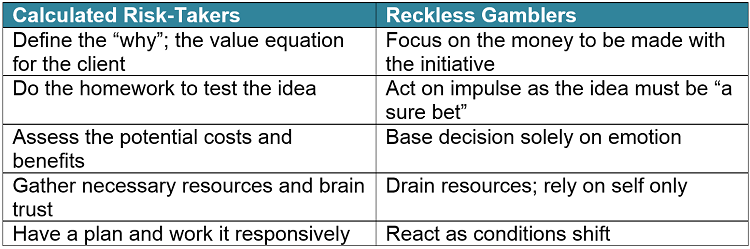
Indeed, in my coaching practice, I’ve observed 5 ways accomplished risk-takers differentiate themselves from gamblers:

risk_chart

But at the foundation of all of this is to have a lower level of fear than most people, or even an absence of fear. Because it is fear that keeps us from considering those decisions and actions that are outside of the box, and that will take our business and career from safe and small to extraordinary.

So we tell ourselves that people must just be born with a risk-taking quotient, and that it doesn’t run in our family. This is our excuse for removing ourselves from the equation. We then step back into our ordinary space, playing it safe and small, while others take the leaps and celebrate the rewards.

However, risk-taking isn’t a genetic trait – it’s acquired. You can, at any age, acquire the tools, skills, and knowledge to become a calculated risk-taker, and learn to avoid the pitfalls of those encountered by the reckless gambler.

So it’s back to confronting and overcoming the fear, because the approach to risk-taking can be learned. I’ll be writing about a specific method I use with clients to do this in my next article.

But meanwhile, what fear is holding you back from getting what you want?  And how do you move past it? Join us on LinkedIn to share, and for more discussion.

—

Patti Cotton helps women executives optimize their effectiveness in leading self, others, and enterprises. Her areas of focus include confidence, leadership style, executive presence, effective communication, and masterful execution. With over 25 years of leadership experience, both stateside and abroad, Patti works with individuals, teams, and organizations across industries, providing executive coaching, women’s leadership development, change, and conflict management. She is also a Fortune 500 speaker. For more information on how Patti Cotton can help you and your organization, click here.

Patti Cotton

Patti Cotton reenergizes talented leaders and their teams to achieve fulfillment and extraordinary results. For more information on how Patti Cotton can help you and your organization, click here.

  • « Go to Previous Page
  • Page 1
  • Page 2
  • Page 3
  • Go to Next Page »

Primary Sidebar

Patti Cotton
Tweets by @PattiCotton
  • About
  • Consulting
  • Training
  • Speaking
  • Blog
  • Contact
Home | Contact | Privacy Policy

© 2024 Cotton Group LLC | PATTI COTTON 360° LEADERSHIP®