• Skip to main content
  • Skip to primary sidebar

Patti Cotton

Executive Coach & Career Strategist

  • About
  • Consulting
  • Training
  • Speaking
  • Blog
  • Contact

ceo

When You Get Thrown Under the Bus at Work

January 23, 2019 By Patti Cotton 2 Comments

When You Get Thrown Under the Bus at Work
Image Credit: Shutterstock

If you’ve worked long enough, then you probably know what it’s like to be thrown under the bus. This idiomatic phrase means to have your reputation deliberately sacrificed by another for that person’s personal gain or advancement.

What do you do when you are caught in the middle of this situation? And how do you recuperate from such a betrayal?

Cameron was a rising star whose contributions were always appreciated on any team. Newly promoted to Executive Vice President, he was assigned to expand the company’s reach into all 50 states.

One particular project involved another executive, Sandra, who had been a contender for Cameron’s position. She was cordial as they worked together on this, but when the time came to report formally to the board on how the initiative was shaping up, she blamed her lack of progress on Cameron.

“I’m afraid I haven’t been able to move forward as I would have liked,” said Sandra. “It’s been a little difficult to get the information I need to do my part since Cameron has been consumed with all of his other projects. You’ve been hard to chase down, my friend,” she gave Cameron a rather condescending smile. “We’ll just have to try harder.”

Cameron told me later that the top of his head become so hot when this happened that it felt like it was going to explode. He looked at Sandra in disbelief. He had been accessible at every turn, and had told Sandra how to reach him if she couldn’t find him. And this? This was clearly a move to discredit him as leader in his new position.

What would you do if a colleague threw you under the bus?

Here’s what Cameron did – and what I want to share with you, so that if you find yourself in a similar situation, you can recoup quickly and rise victorious.

1. Pre-empt any barreling bus by making sure you already have a solid reputation.

The best way to avoid people doubting your ability to do the work is to establish a strong track record through your integrity (your approach) and your ability to execute and deliver (your competence). When you have this background experience, people will remember when an isolated incident questions your leadership.

Cameron enjoyed a stellar reputation with others and so those in the room witnessing Sandra’s blame quickly questioned her motives – not Cameron’s abilities.

2. Take a short walk before you decide how to handle this.

Before you decide how you want to address being run over, take a short walk. Get outside, breathe, move around. It’s important to take a pause as you process what just happened and what you want to do to remedy it. On mental, emotional, and physical levels, this gives you the spaciousness of time to cool down and think through a best response.

Cameron got out the door as soon as the presentation was over and took a good 10-minute walk before he calmed down enough to process. Once he got his emotions under control, he was able to think through next best steps for salvaging his reputation with the board.

3. Confront for the record.

Meet with the person who just threw you under the bus.

Cameron was direct and thoughtful. “Sandra,” he began. “I was surprised in there to hear that you didn’t get the time you needed with me in order to meet the deadline. I must apologize if I appeared inaccessible. Can you share more?”

Sandra, of course, was hedging, hemming, and hawing. She knew she was caught, but thought she could wiggle out. “Well, Cameron,” she answered, “whenever I would walk past your door to check in, you seemed very busy…on a conference call, in the middle of a meeting…it was just very awkward.”

Cameron didn’t back down, but created a net for the future. “Sandra, in future, if I seem caught up and don’t notice you, it will be helpful if you shoot me an e-mail or call to schedule time. This project is high priority – and I will always make time for you as a valued team member to support you in your part.”

Sandra was caught and she knew it. The excuse was lame – but she was proud. She agreed that next time, she would make an appointment. “And one more thing, Sandra – if you aren’t not getting the answers or resources you need from me, I hope you will tell me so that I can rectify that. Will that work for you?” Sandra was officially put on notice – no more blame game.

4. Restore your reputation through a third-party champion.

At times like these, you know that anything you say publicly will simply sound like defensive excuses. In this case, you need a champion to boost your good name. Pick a trusted colleague who has influence or “power clout” with those who witnessed the crash and share what has happened. Allow them, over the next few days, to do some subtle, positive PR on your behalf when you aren’t in the room.

Having someone else speak highly of you and your abilities in this way is powerful. You take the high road; your colleague reinforces how great you are doing and why you are definitely the right person in the right seat – and you can relax.

If you have ever been thrown under the bus, then you know how devastating it is.

Be sure you are a person who never resorts to that – and commit to being a champion for others.


© Patti Cotton and patticotton.com. All rights reserved. Unauthorized use and/or duplication of this material without express written permission from the author is strictly prohibited. Excerpts and links may be used, provided that attribution is made to Patti Cotton and patticotton.com, with links thereto.

Patti Cotton

Patti Cotton reenergizes talented leaders and their teams to achieve fulfillment and extraordinary results. For more information on how Patti Cotton can help you and your organization, click here.

Three Steps to Getting Your Team on Board

January 16, 2019 By Patti Cotton Leave a Comment

Three Steps to Getting Your Team on Board
Image Credit: Shutterstock

Have you come away from a team meeting confident that everyone is on board and ready to go? This is exactly what you needed in order to move the initiative forward.

But later, when you call people to action, you get pushback. They argue about time or resources. Somebody points to the executive down the hall.

“What about Jim?” they chide. “He ought to step up – he doesn’t have half the workload we do!”

How do you avoid arriving at this place? What can you do to make sure everyone is aligned and engaged?

Here are three steps to take so you can get your team on board from the get-go:

  1. Create psychological safety.

Your people need to know that, within the team, it is safe to take a risky stance. Such safety supports productive disagreement. Psychological safety requires that your team develop high trust with one another. How much does your team trust one another? For more on this, get the downloadable infographic below.

HOW MUCH

DO OTHERS REALLY TRUST YOU?

​Learn the two vital parts to trust and how they can help you become a more highly effective leader.

GET THE INFOGRAPHIC

  1. Surface assumptions.

Every human being comes equipped with assumptions. These are a result of our life experiences.

Is it summertime? The sky should be blue.

Is it dinner time? People should be getting hungry.

Some assumptions are not dangerous, and they help to guide us with everyday decisions. On the other hand, some assumptions can interfere with reaching consensus and alignment on important issues.

How can you ferret these out before they get in the way?

When your team meets, present the problem or initiative. Then, before they can ask questions or present any opinions, ask them what assumptions they will use in order to work together on this.

Are they assuming this will require…

  • Redirecting the workforce?
  • Additional budget considerations?
  • That their role will be modified in some way?

What other assumptions will they have?

Bring these to the surface and ask your team members to put these aside as you work. They may not be factors, and you will be able to address concerns more quickly as you move through the discussion.

  1. Expose misalignments.

Team members may feel agreeable during the discussion. However, some may not have thought things through in such a way that it reveals hidden roadblocks.

Get creative to stir things up. Consider taking discussions about new initiatives off-site. Present your idea as a hypothetical one and have them develop it as a team exercise.

Now, have them identify problems and work together to solve these.

After you have laid this foundation of collaboration, ask them to make it real, and talk about what it will take for the team to implement this. Again, have them problem-solve together.

Your team can begin to flex and increase its ability to perform at levels most will never experience.

I look forward to hearing how this works for you.

For more on psychological safety, see Amy Edmondson’s article, “Psychological Safety and Learning Behavior in Work Teams”, Administrative Science Quarterly; Jun 1999; 44, 2.

Patti Cotton

Patti Cotton reenergizes talented leaders and their teams to achieve fulfillment and extraordinary results. For more information on how Patti Cotton can help you and your organization, click here.

Kintsugi and Strengthening Your Leadership

December 19, 2018 By Patti Cotton 1 Comment

Kintsugi and Strengthening Your Leadership
Image Credit: Shutterstock

How have you become the leader you are today? Your leadership has been shaped by the lessons you have learned in the past.

And when a particularly tough challenge throws you to the mat, this can be when you become the strongest.

But why is it when we fall flat on our backs that we are embarrassed and try to conceal this?

We are doing ourselves and others a disservice when we do so.

How?

Kintsugi.

The philosophy of Kintsugi is to treat breakage and repair as part of the history of the object, rather than a failure or flaw that should be disguised.

The story of how Kintsugi was born is that a 15th century ruler once broke a rare and favorite bowl. Because of the history it represented to him, he sent it far away for repairs. When the bowl was returned, it was in poor shape, cobbled together with large and unsightly staples. The accompanying message said that the bowl was irreparable.

Because he valued the bowl so highly, the ruler was willing to accept this verdict. He then sought someone who could take new, creative measures to restore it.

The result was Kintsugi.

Kintsugi is the ancient art of repairing broken pottery with lacquer dusted with gold, silver, or platinum.

Instead of hiding the breaks, it highlights them with one of these beautiful metals to embrace cracks and repairs as simply part of the object’s journey, rather than to consider that breakage ends its service.

What does this mean for your leadership?

You certainly haven’t thrown in the towel because you have met some difficult challenges. However, many of us in leadership may treat these moments as non-events in an effort to appear strong and unflawed.

This is a disservice.

To feign perfection in an effort to appear strong can discount growing from your experience.

Moreover, those around you need to understand that developing their own leadership means recognizing failures as valuable points of learning that make them even stronger.

If you aren’t confident enough to talk about the history behind some of your cracks and breakages, and to reframe these as part of the leader journey, then you are robbing others of their own valuable growth opportunities.

How can you begin to turn past bumps in the road into marks of beauty in your leadership?

Think back on a particular instance and ask yourself the following questions:

  1. What did you learn from having encountered this difficulty?
  2. What was the hidden “gold” in the failure?
  3. How have you used this since – and how has it made you a stronger leader?

By reframing past failures as points of learning, you can now recognize these as part of the beauty of your leadership. And you provide inspiration and hope for those who are following behind.


HOW MUCH

DO OTHERS REALLY TRUST YOU?

​Learn the two vital parts to trust and how they can help you become a more highly effective leader.

GET THE INFOGRAPHIC

Patti Cotton

Patti Cotton reenergizes talented leaders and their teams to achieve fulfillment and extraordinary results. For more information on how Patti Cotton can help you and your organization, click here.

Peter Drucker – Goals and Self-Control

December 12, 2018 By Patti Cotton Leave a Comment

Peter Drucker - Goals and Self-Control
Image Credit: Shutterstock

Peter Drucker once stated that his mission was to help other people achieve their goals.

Helping people reach their big leadership goals is what I do. If I can help them develop their leadership, they can then achieve the personal and professional things they set out to do.

And at face value, it’s easy to reach your goals.

To do this, all you need are these three things.

  • Define your goal
  • Identify the steps and ways to get there
  • Practice the self-control to work the plan

But a lot of leaders don’t reach the goals they set for themselves. Why? If the formula is so simple, where is the hitch?

To give some insight on this, I’d like to share some background about meeting objectives and reaching goals by reflecting on Peter Drucker. Drucker, a widely influential thought leader, has been described as the founder of modern management. I believe his work holds the key.

Drucker invented the concept of management by objectives and self-control, somewhat of a “household idea” in strategic planning today. He popularized this idea in his 1954 book, The Practice of Management.

Drucker maintained that in order to effectively reach objectives, these must first be defined by management and conveyed to other members of the organization. Then, it must be decided as to how to reach these objectives (strategies), and these strategies must then be broken down into sequential steps (tactics). The resulting outline or strategic action plan could then be used as a roadmap for those who had assigned responsibilities therein.

Drucker’s theory proposed to create an organized and positive work environment. As people worked the steps in the plan, they would be motivated by their achievements and spurred to continue on to the “finish line.”

Let’s translate all this into you as leader as you work on developing your own leadership.

Most of you reading this can easily identify the goals that are important to you. You can probably also outline the steps you need to take in order to reach your goals.

But you may not be reaching these.

What’s missing?

Self-control.

A lack of self-control is usually the culprit in thwarted goals. This is when leaders often call an executive coach. They’ve read the books, attended the boot camps, and yet, little has changed. And they aren’t quite sure what to do about it.

If this is you, it’s easy to feel discouraged and fall back into old patterns. After all, good enough is good enough – right?

But quietly, you know that if you develop greater leadership, you’ll benefit not only yourself and those around you, but the entire organization.

If you are at this point, I challenge you to adopt the following four tools.

These will help you to develop more self-control to move past obstacles and on to success.

1. Begin in a corner to set yourself up for success.

Is your goal to be a better communicator? Identify two to three things that will help you to become one. And then, start with just one of those. Let’s say your three strategies to becoming a better communicator include being a better listener, asking more questions, and being clearer and more concise in your written communications. Attempting to shift to all three of these behaviors at once is too much and will discourage the best of us. Begin with the one that feels easiest or like the biggest win, and work on that for a few weeks before taking on the next shift.

2. Assume a can-do attitude in your language.

What are the things you say to yourself when you think about taking that next step toward goal? Does your language feel heavy, full of examples like, “I need to…” “I have to…” “I must…”? Try shifting this type of language to one that is more encouraging, such as, “I am looking forward to trying…” “It’s fun to think about experimenting with this…” Look for the negatives and turn these around. Your language reinforces attitude with feelings around the work you need to do to reach goal.

3. Keep the transformation in mind.

If being a better listener is your goal, the transformation might be that by being a better listener, others will respect you more, share more, feel recognized, etc. and this will help to motivate and engage them, resulting in greater outcomes. Identify this transformation and keeping it in front of you as a carrot is powerful to helping you stay the course.

4. Congratulate yourself for wins and points of learning.

One step at a time. Each time you move a little closer to your goal, congratulate yourself. Each time you recognize when you have taken a step back, look at this as a point of learning. Ask yourself what you will do differently next time to move forward. The brain needs this in order to flex where it needs to go next. Rome wasn’t built in a day – and neither has your leadership been developed overnight. Decide that it’s “brick by brick” and keep going.

As you contemplate 2019 and what you would like to see in your personal leadership, remember that this is a journey. By traveling in this way, you model this for others, providing encouragement and a sound way forward.


HOW MUCH

DO OTHERS REALLY TRUST YOU?

​Learn the two vital parts to trust and how they can help you become a more highly effective leader.

GET THE INFOGRAPHIC

Patti Cotton

Patti Cotton reenergizes talented leaders and their teams to achieve fulfillment and extraordinary results. For more information on how Patti Cotton can help you and your organization, click here.

100 Best Performing CEOs: How Do You Measure Up?

November 21, 2018 By Patti Cotton Leave a Comment

100 Best Performing CEOs: How Do You Measure Up?
Image Credit: Shutterstock

The Harvard Business Review (HBR) has just come out with its annual list of 100 best performing CEOs in the world.

Who are these leaders and what makes them different?

The team at HBR uses tough criteria to identify and rank these CEOs, assessing their capability to lead in a volatile world.

How do you measure such capability?

Outcomes.

Quite a bit of HBR’s process involves reviewing the profitability and forward movement of the company, seeing how well it sustains momentum in the midst of challenging outside forces – “savvy competitors, demanding customers, profit-hungry investors, political and economic headwinds” (Best Performing CEOs in the World 2018).

How would you measure up?

Is it fair to judge you as leader when external forces aren’t in your control?

Yes and no.

You certainly cannot change or control external forces.

But you can change the way you meet them.

And this is exactly how these 100 best performing CEOs became part of HBR’s list.

Of course, vision, strategy, and focused action all played into successful outcomes. But what makes the difference for winners once the plans are in place are two things: steadiness and stability.

That’s right – steadiness and stability.

Sound dull? These are two of the most underrated traits in leadership – and yet, two of the most important.

Steadiness is the ability to continue pushing through even at the toughest times so that you can emerge from the toughest of maelstroms. And stability is a foundational strength that provides focus, security and safety.

It stands to reason that, unless you can lead with steadiness and stability, you will compromise your targeted success.

I recall a time in my younger years when my then 35-year-old father left his teaching position to develop healthcare facilities. His vision and strategy were sound, and against all odds, he first developed a retirement center, a convalescent and rehab center, and a hospital all within three years. The city sorely needed these facilities – even the hospital which was just a mile from a larger more established one. The administrator of the latter had shared with Dad that they needed overflow facilities and if Dad would develop a community hospital, there were patients waiting.

So Dad began developing these with a passion and determination that were unparalleled. But he met with great resistance. Someone in town complained that if another hospital was built, that his dog would be nervous. Someone else tried to get in front of Dad and quickly develop a hospital before he did, even after Dad had procured the licenses and permissions necessary to break ground. There were fights and opposition all around. And 16 City Council hearings. Sixteen.

I reflect on that and ask how many people would have weathered all this at 35 years old. In the end, he won – and so did the town, which has benefited from these facilities for several decades, now.

But Dad could not have done this without unwavering steadiness – the commitment to push through even when incredibly discouraged and feeling alone. He could not have done this without the stability that his vision gave him – the strength and commitment to move with focus.

How would you rank your steadiness? And your stability in the face of opposing winds?

Here is my personal challenge to you for growth:

  • During this upcoming holiday season, I invite you to reflect on those times when you have faced difficulty, but still pushed through to successful outcomes. Celebrate this!
     
  • Ask yourself where there is room for more steadiness in your leadership…more stability. What stretch goals do you have for yourself, your team, for the company – and how will these traits play into reaching them?
     

Are you interested in developing greater leadership capacity in your work and life?

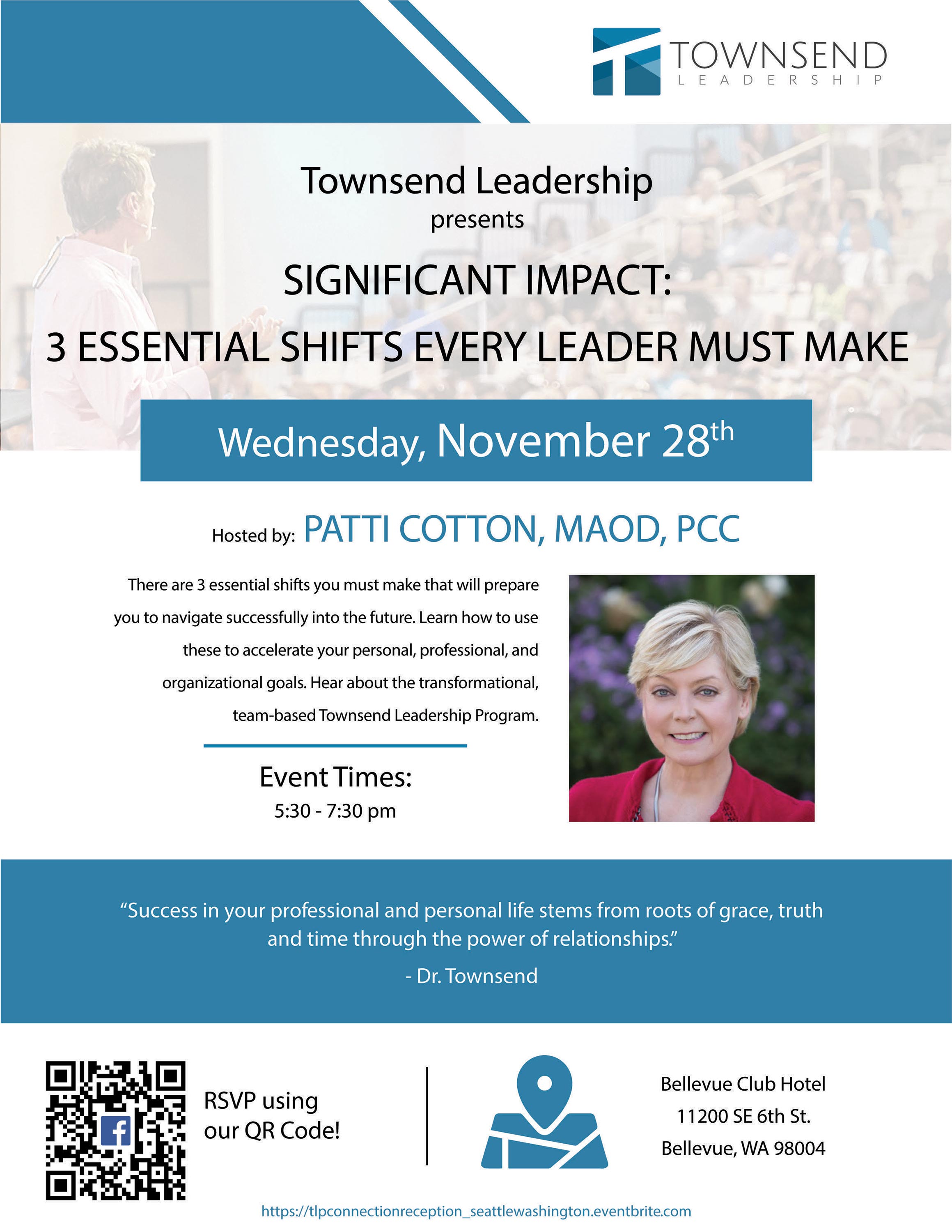
Come and join me at the Bellevue Club Hotel in the Seattle area on November 28 to hear more about how you can do so. Seating is limited and folks are flying in to attend, so please rsvp only if you are sure you can be there: https://www.eventbrite.com/e/3-essential-shifts-every-leader-must-make-tickets-51973207262.

Or for Southern California leaders, e-mail me at patti@patticotton.com for details of a private upcoming event in the Inland Empire.

Townsend Leadership

Patti Cotton

Patti Cotton reenergizes talented leaders and their teams to achieve fulfillment and extraordinary results. For more information on how Patti Cotton can help you and your organization, click here.

  • « Go to Previous Page
  • Page 1
  • Interim pages omitted …
  • Page 13
  • Page 14
  • Page 15
  • Page 16
  • Page 17
  • Interim pages omitted …
  • Page 22
  • Go to Next Page »

Primary Sidebar

Patti Cotton
Tweets by @PattiCotton
  • About
  • Consulting
  • Training
  • Speaking
  • Blog
  • Contact
Home | Contact | Privacy Policy

© 2024 Cotton Group LLC | PATTI COTTON 360° LEADERSHIP®