• Skip to main content
  • Skip to primary sidebar

Patti Cotton

Executive Coach & Career Strategist

  • About
  • Consulting
  • Training
  • Speaking
  • Blog
  • Contact

strategy

The Role of Mindset in Leadership Success

July 31, 2024 By Patti Cotton Leave a Comment

The Role of Mindset in Leadership Success
Image Credit: Depositphotos

When it comes to leadership, the importance of mindset cannot be overstated. How leaders perceive challenges, handle feedback, and inspire their teams is deeply rooted in their mindset. A growth-oriented mindset can transform obstacles into opportunities, fostering an environment where both the leader and their team can thrive.

The Struggle

James was the CEO of a mid-sized tech company that had seen rapid growth over the past few years. When he reached out, he had been struggling to maintain this momentum and keep his team motivated. The market was more volatile than ever, and the competition was fierce.

“I’m overwhelmed,” he told me. “I’m not sure about my ability to steer the company through such choppy waters.”

He was convinced that his main issue was external—market volatility and increasing competition. Seeing these challenges as insurmountable obstacles, he felt stuck and unable to come up with effective solutions. His team sensed James’ stress and self-doubt.

The Source

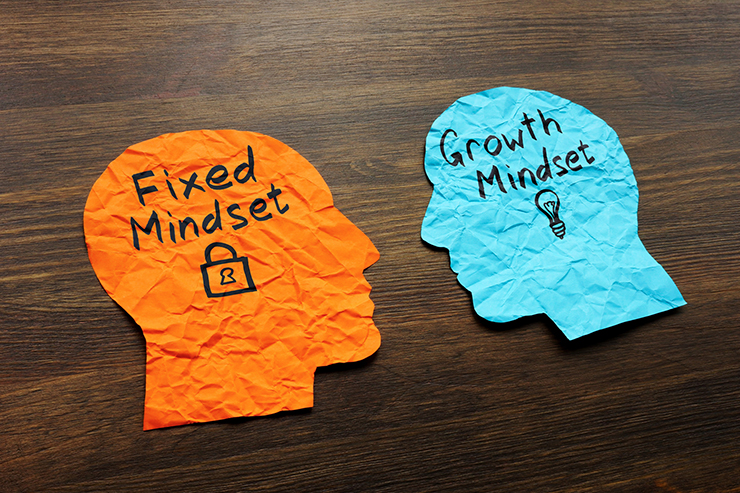
To get to the heart of his struggles, let’s examine James’ mindset. Drawing on Carol Dweck’s research on fixed and growth mindsets, we can see why he would hit a wall.

A fixed mindset assumes abilities and intelligence are static, while a growth mindset believes they can be developed through effort and learning.

James certainly exhibited a fixed mindset.

He saw the current challenges as beyond his control and doubted his leadership abilities were enough to overcome them. This mindset limited his capacity to adapt, innovate, and inspire his team.

This hindered his effectiveness and created a culture of fear and resistance to change. Team members became reluctant to take risks or propose new ideas, leading to stagnation and missed opportunities.

James needed to pivot quickly, or he risked losing his team and his company.

The Strategy

To jumpstart turning things around, we convened off-site for two days to set a vision for his leadership, craft an actionable strategic plan with immediate actions, and do some deeper interventional work to diffuse the origins of his fixed mindset.

We then worked over the next few months to continue cultivating his growth mindset and his abilities to deal with the internal and external challenges that his company faced.

The Shift

James’ team noticed the difference right away, and in the coming weeks and months, their morale and trust rose along with James’ ability to lead and the positive outcomes this produced. It was a pleasure for me to sit in on some of the meetings to observe and support James as he made incremental shifts that made a monumental difference.

How much of a growth mindset do you have? Check yourself here – how do you rate?

  1. I am confident and at ease in embracing challenges.
    • I view challenges as opportunities for personal and professional development.
    • I encourage risk-taking and innovation within the team.
  2. I appreciate learning from constructive feedback.
    • I use constructive feedback as a tool for growth rather than a personal attack.
    • I create an open environment where feedback is welcomed and valued.
  3. I persist in the face of setbacks.
    • I develop resilience by learning from failures and persevering through difficulties.
    • I share stories of past challenges and how they were overcome to inspire the team.

Here are some tips to foster a leader’s growth mindset:

  1. Practice Mindfulness
    • Engage in mindfulness practices such as meditation to increase self-awareness and emotional regulation.
    • Mindfulness helps leaders stay present, reducing stress and improving decision-making. Sarah can start her day with a brief mindfulness session to center herself and approach challenges with a calm and focused mind.
  2. Continuous Learning
    • Commit to lifelong learning by regularly reading books, attending workshops, and seeking new experiences.
    • Encourage the team to pursue personal development opportunities. Sarah can create a learning culture within her organization by providing resources and incentives for continuous education and professional growth.
  3. Surround Yourself with Growth-Minded People
    • Build a network of mentors, peers, and advisors who embody a growth mindset.
    • Engage in regular discussions with these individuals to gain new perspectives and insights. Sarah can join industry groups and networking events to connect with other growth-minded leaders and learn from their experiences.

Mindset matters—a lot.

The mindset of a leader significantly influences their effectiveness and the success of their organization. By shifting from a fixed mindset to a growth mindset, other leaders like James can transform challenges into opportunities for growth and innovation. Embracing challenges, learning from constructive feedback, and persisting in the face of setbacks are key steps in fostering a growth mindset.

Cultivating a growth mindset is an ongoing journey that can transform leadership effectiveness and overall organizational success. By practicing mindfulness, committing to lifelong learning, and surrounding themselves with growth-minded individuals, leaders can create a culture of growth and fulfillment within their organizations.

If you’re a leader feeling stuck, take a step back and ask yourself: Is it time for a mindset shift? You might be surprised at the doors it opens.


© Patti Cotton and patticotton.com. All rights reserved. Unauthorized use and/or duplication of this material without express written permission from the author is strictly prohibited. Excerpts and links may be used, provided that attribution is made to Patti Cotton and patticotton.com, with links thereto.

Patti Cotton

Patti Cotton reenergizes talented leaders and their teams to achieve fulfillment and extraordinary results. For more information on how Patti Cotton can help you and your organization, click here.

Five Ways to Sound More Strategic

October 30, 2019 By Patti Cotton Leave a Comment

Five Ways to Sound More Strategic
Image Credit: Shutterstock

Is your strategy showing? You may be a knowledge expert with a strong leadership lens, but unless others can see it through the way that you present your ideas, they may discount your expertise.

How can you showcase your ability to be strategic, so others take you more seriously?

1. Lead with the end in mind.

Give the answer first, and then back this up by bulleting your main points before you go into details. This is a strong way to begin your delivery and helps listeners remain focused as they know what to anticipate.

Here is an example:

The Answer: “We will be expanding into Texas, Georgia, and Virginia.”

Bullet Points: The three reasons we have decided to do this are:

    1. The cost of doing business;
    2. Available workforce; and
    3. A solid economy.

The Details: Here’s why…(go into each one of your points to expand as much as you need to provide backup with evidence while keeping it succinct).

2. Eliminate distractors.

Rambling and awkward fillers such as “um” and “uh” give the perception of searching for answers and weaken your message and credibility.

Record yourself with your phone a few times to identify what fillers you might inadvertently be using.

    • Do you repeat yourself in an attempt to convince?
    • Do you ramble with tactics instead of remaining linked to the broader context?

Redirect as you relax in the knowledge that others will ask questions if they need clarification.

3. Link your ideas to broader goals.

Whenever you can, refer to the broader strategic goal that your idea supports. Demonstrating that you keep the organization’s goals and the broader picture in mind when considering problems reminds others that you are a leader.

4. Play the devil’s advocate.

Show that you consider multiple perspectives as you make decisions and move through creative problem-solving. This can be done by referring to other possible solutions you considered before arriving at your conclusion. Share with the listeners how these other approaches worked (or didn’t!), and why you feel your solution is best. Others will see that you followed a carefully researched and open-minded approach to the problem, and this builds trust.

Jumpstart Company Performance with Trust

5. Back up your idea with the business impact.

Identify the ways in which your idea or solution will have a positive impact on the business. If you can show this, and line it up with larger goals (more revenue, shorter product cycles, etc.), you will gain credibility quickly.

Translating your strategic thoughts into words will take practice, but the outcome is well worthwhile. If you want others to recognize your strategic abilities, show them the depth and breadth of your thinking as you speak.

HOW MUCH

DO OTHERS REALLY TRUST YOU?

​Learn the two vital parts to trust and how they can help you become a more highly effective leader.

GET THE INFOGRAPHIC


© Patti Cotton and patticotton.com. All rights reserved. Unauthorized use and/or duplication of this material without express written permission from the author is strictly prohibited. Excerpts and links may be used, provided that attribution is made to Patti Cotton and patticotton.com, with links thereto.

Patti Cotton

Patti Cotton reenergizes talented leaders and their teams to achieve fulfillment and extraordinary results. For more information on how Patti Cotton can help you and your organization, click here.

100 Best Performing CEOs: How Do You Measure Up?

November 21, 2018 By Patti Cotton Leave a Comment

100 Best Performing CEOs: How Do You Measure Up?
Image Credit: Shutterstock

The Harvard Business Review (HBR) has just come out with its annual list of 100 best performing CEOs in the world.

Who are these leaders and what makes them different?

The team at HBR uses tough criteria to identify and rank these CEOs, assessing their capability to lead in a volatile world.

How do you measure such capability?

Outcomes.

Quite a bit of HBR’s process involves reviewing the profitability and forward movement of the company, seeing how well it sustains momentum in the midst of challenging outside forces – “savvy competitors, demanding customers, profit-hungry investors, political and economic headwinds” (Best Performing CEOs in the World 2018).

How would you measure up?

Is it fair to judge you as leader when external forces aren’t in your control?

Yes and no.

You certainly cannot change or control external forces.

But you can change the way you meet them.

And this is exactly how these 100 best performing CEOs became part of HBR’s list.

Of course, vision, strategy, and focused action all played into successful outcomes. But what makes the difference for winners once the plans are in place are two things: steadiness and stability.

That’s right – steadiness and stability.

Sound dull? These are two of the most underrated traits in leadership – and yet, two of the most important.

Steadiness is the ability to continue pushing through even at the toughest times so that you can emerge from the toughest of maelstroms. And stability is a foundational strength that provides focus, security and safety.

It stands to reason that, unless you can lead with steadiness and stability, you will compromise your targeted success.

I recall a time in my younger years when my then 35-year-old father left his teaching position to develop healthcare facilities. His vision and strategy were sound, and against all odds, he first developed a retirement center, a convalescent and rehab center, and a hospital all within three years. The city sorely needed these facilities – even the hospital which was just a mile from a larger more established one. The administrator of the latter had shared with Dad that they needed overflow facilities and if Dad would develop a community hospital, there were patients waiting.

So Dad began developing these with a passion and determination that were unparalleled. But he met with great resistance. Someone in town complained that if another hospital was built, that his dog would be nervous. Someone else tried to get in front of Dad and quickly develop a hospital before he did, even after Dad had procured the licenses and permissions necessary to break ground. There were fights and opposition all around. And 16 City Council hearings. Sixteen.

I reflect on that and ask how many people would have weathered all this at 35 years old. In the end, he won – and so did the town, which has benefited from these facilities for several decades, now.

But Dad could not have done this without unwavering steadiness – the commitment to push through even when incredibly discouraged and feeling alone. He could not have done this without the stability that his vision gave him – the strength and commitment to move with focus.

How would you rank your steadiness? And your stability in the face of opposing winds?

Here is my personal challenge to you for growth:

  • During this upcoming holiday season, I invite you to reflect on those times when you have faced difficulty, but still pushed through to successful outcomes. Celebrate this!
     
  • Ask yourself where there is room for more steadiness in your leadership…more stability. What stretch goals do you have for yourself, your team, for the company – and how will these traits play into reaching them?
     

Are you interested in developing greater leadership capacity in your work and life?

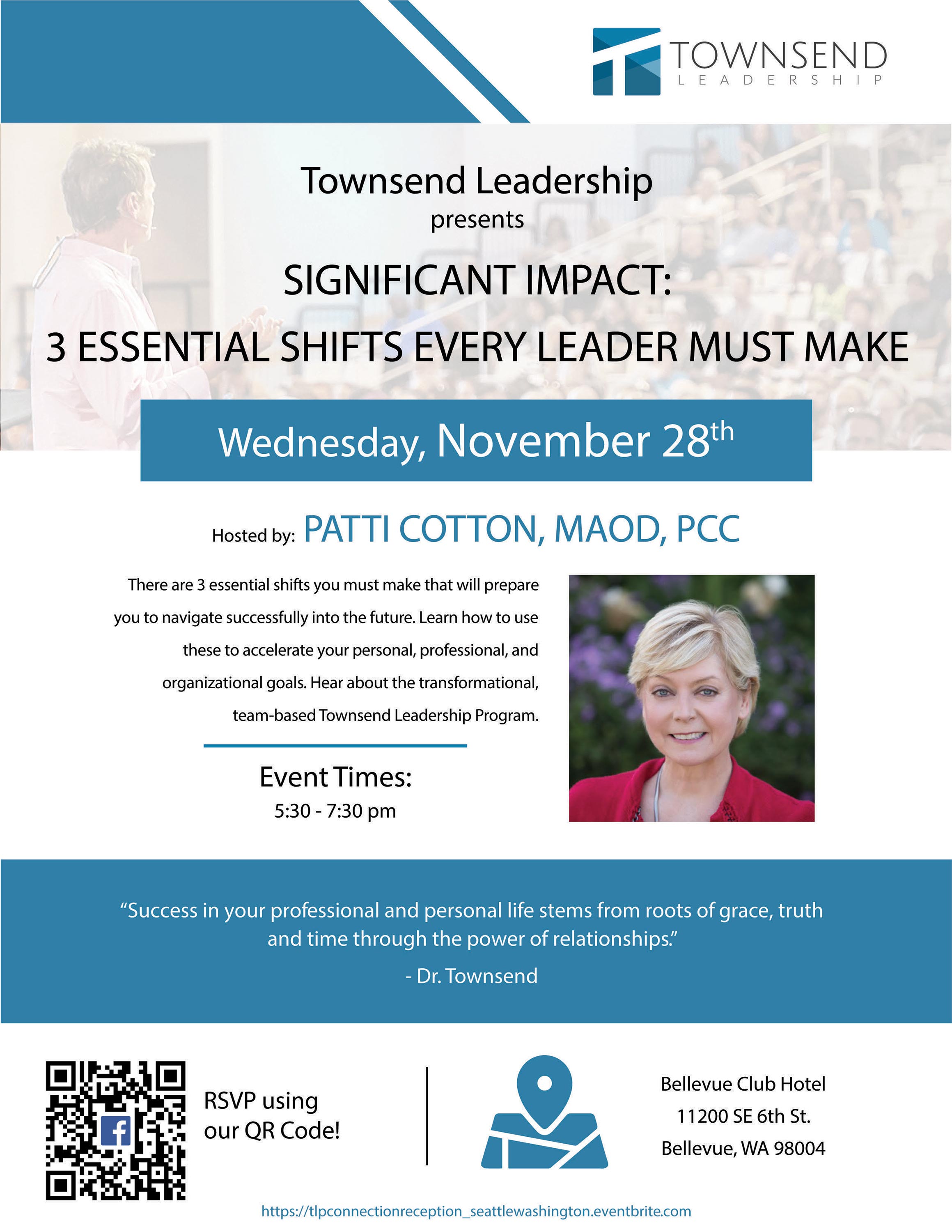
Come and join me at the Bellevue Club Hotel in the Seattle area on November 28 to hear more about how you can do so. Seating is limited and folks are flying in to attend, so please rsvp only if you are sure you can be there: https://www.eventbrite.com/e/3-essential-shifts-every-leader-must-make-tickets-51973207262.

Or for Southern California leaders, e-mail me at patti@patticotton.com for details of a private upcoming event in the Inland Empire.

Townsend Leadership

Patti Cotton

Patti Cotton reenergizes talented leaders and their teams to achieve fulfillment and extraordinary results. For more information on how Patti Cotton can help you and your organization, click here.

Five Reasons Executive Coaching Experiences Fail

April 18, 2018 By Patti Cotton Leave a Comment

Five Reasons Executive Coaching Experiences Fail
Image Credit: Shutterstock

You realize that developing your leadership and that of your team gives you a competitive advantage. After all, behavior is what drives your company’s strategy, structure, culture, and systems.

You are also starkly aware that what got you to this point won’t carry you into the future. In this complex world, a commitment to developing talent at all levels of the enterprise is not a nice idea – it’s a necessity.

Where do you start? You’ll want to model from the top, and so you are probably thinking that a first good step would be to hire a coach for you and key members of your executive team.

Executive coaching has been highly recommended to you as leader as the best answer to your development.  You’ve read the statistics and they sound promising. The ROI for executive coaching has a healthy average of 7 to 10 times the investment, with some even reporting up to 49 times.

But you have a nagging doubt that has kept you from making a move to start the process. What if it doesn’t work for you? You’ve heard of a couple of stories where another decision-maker’s coaching experience didn’t meet expectations. Wasted time, energy, and money.

How can you make sure you get the same great results you keep reading about – and move confidently as you meet the future, now?

Here are 5 reasons that executives might not get the kind of return you read about – and how to start out right so that you can make an investment that pays off well for you.

Five Reasons Executive Coaching Experiences Fail

1. You don’t know what kind of coach you need.

Opening a coaches’ directory will reveal different kinds of coaches, and the choice can be overwhelming. Here are the three primary types of coaches so that you can see the difference:

a. Life coach – focuses on the whole person, personal and professional goals, aspects of life such as health, wellness, personal finances, life direction, and more.

b. Business coach – brings processes, tools, and concepts to team and enterprise growth (business coach and business consultant are closely related with quite a bit of overlap). Works on a variety of goals, including strategy, marketing, overall performance, and more.

c. Executive coach – helps unlock leadership potential, facilitating change in someone’s personal behavior that will ultimately result in achieving business goals. Executive coaches are typically hired to help C-suite, VPs and other executives with setting, supporting, and achieving personal improvement goals. Examples of focus can include developing greater leadership skills, managing staff, improving communication, managing conflict well, increasing productivity, increased agility, decision-making, and more.

2. Your coach doesn’t have the formal training and certification to be most effective.

Has your coach had the benefit of a robust accredited coaching program that utilizes proven methodologies for best adult learning and development?  And are they certified with the International Coach Federation or similar accrediting body so that you can be sure they meet highest standards in ethics and in practice?

3. Your coach doesn’t use a solid model and framework for results.

Unless your coach can use a solid model and process that keeps you focused on the goals you set with them, keeps you moving forward, allows you to assess progress as you move forward, and has the ability to truly measure outcomes, then you will not be able to bank on best results.

4. Your coach can’t meet you at your level to provide the support you need.

Coaches vary in their own levels of personal development and leadership experience. A coach does not need your industry background, or to have held the same position you now hold. However, they need to be able to help you navigate your growth and understanding where you are in your development and how you meet the world is vital to their asking the right questions to do so. The coach’s own leadership background, as well as their past client roster and client testimonials should be helpful indicators as to whether they can support you well in this regard.

5. You aren’t willing to do the work.

Change is challenging, and it requires great courage and vulnerability to look at one’s own “growing edges.” Many clients have hired coaches, only to go through the motions and not give the initiative the focus necessary to truly develop self. If you recognize that you are ready to step into a higher level of leadership, make the commitment to do the work. The results are life-changing when you give it 100%.

In order to manage well in an ever-evolving, complex world, having an able thought partner who helps you to see the landscape and navigate well is priceless. The ROI of executive coaching can be a game-changer for you, your team, and the company, if you are confident in how to go about selecting a coach, and if you make a strong commitment to change.

Patti Cotton

Patti Cotton reenergizes talented leaders and their teams to achieve fulfillment and extraordinary results. For more information on how Patti Cotton can help you and your organization, click here.
The Clockwork of Excellent Leadership: 3 Essential Gears

August 9, 2017 By Patti Cotton Leave a Comment


What makes up excellent leadership?

The workings of excellent leadership are essentially the same, whether you are a small business owner or a large corporate executive. It doesn’t matter what the industry, in which country or countries you do business, and whether your staff is comprised of millennials or seasoned mentors (and I hope you have both!).

What constitutes excellent leadership remains constant.

Imagine, if you will, the business of leadership to be a finely-tuned clock. With this picture in mind, now imagine you are looking at the inside of the clock and that you see three interlocking gears, well-oiled, all turning together to support the clock’s movement. That’s good leadership.

Let’s go further with this analogy. Suppose one of the gears stops working. It gets rusty, or wears down so that one of the teeth breaks off. What happens then? Of course, the gears stop turning, or they turn for a while, begin to misbehave, and then slow to a halt.

Leadership is the same way. The essential components that go into leadership must all work together, or they begin to wear on one another and bring things to a stop.

What are these three “gears”? And how do they work together?

The First Gear: Vision

Vision is the answer to “what’s possible.” It’s where things start – and indeed, one cannot move forward without some kind of vision, some sort of mental picture of what ultimate success can look like.

For an enterprise, vision is the desired future impact the entity aspires to make. It represents the overall goal and global direction of the business, and this rarely changes.

You can see what I mean by the examples of some well-known visions here:

Disney:                        To make people happy.

American Express:      To be the world’s most respected service brand.

Hilton Worldwide:       To fill the world with the light and warmth of hospitality.

In the world of leadership development, much focus has been given to the ability to vision.

Being able to visualize and articulate what is possible for the future of an enterprise is considered a vital component of successful leadership. By the same token, many leaders have been known to fail because of their lack of vision. Indeed, first being able to capture vision, then inspiring it, holding fast to it despite constant change, and keeping one’s eye on it while doing the work required to get there is a huge challenge.

Here are just a few reasons why you and your enterprise require vision – and why it must be defined before you make any moves forward.

  1. Focus

     If you have the end goal in mind, you can focus on it, and thus eliminate shiny objects and other distractions along the way. In the workplace, focus helps you give attention to the right things that will help you reach vision.

  2. Direction

    Vision is your ultimate destination and, when you don’t know where you are going, you might as well drive down any road and just keep traveling. In the workplace, no direction means you are liable to land anywhere – and nowhere specific. That’s death knell for business.

  3. Meaning

    Vision gives context to what you do. It reminds you of the “why” of your enterprise, why it exists. In the workplace, executing your work without understanding why you are doing what you do means disengagement and dissatisfaction.

  4. Motivation

    When you know where you are going and why, this is motivating. You can see as you take action and get closer to goal, and this energizes you. When your employee base is motivated, you will see high engagement and productivity – the stuff that keeps a business going well.

  5. Inspiration

    Vision is inspiring. It’s a lofty and attractive goal that may seem unattainable, but that keeps you climbing toward the top. As you are energized and engaged, so is your staff. They “catch” the vision through your ability to visualize it and articulate it to them so that they can also strive to get there with you.

The Second Gear: Strategy

Strategy is the plan of action for going after the vision. It’s the question, “What is the best way to get there?” Strategy is key to driving direction, and seeks to take the best path to get to the vision. Best ways “to get there” can change, depending on unpredictable market conditions, competitors, disruptive technology, and many other factors.

If you work in a large enterprise, your company or organization is comprised of business units, and these may have multiple teams. Each of these units and each of their teams has a set of strategies to support the larger, more global corporate strategy, which supports the entity’s vision. If you are an entrepreneur or smaller business owner, you will have equally important strategies defined, but less of the strategy “layering” that a larger entity would have, in order to support your enterprise’s vision.

The Clockwork of Excellent Leadership:   3 Essential Gears

What makes up excellent leadership? The essential components that go into leadership must all work together, or they begin to wear on one another and bring things to a stop. Learn how to keep them running like clockwork. Sign up to receive the  complimentary infographic.

Here is how one company redefined a key business strategy because of a changing marketplace.

For years, there were just a few large credit card companies to service the population, and American Express was one of these. However, in the early 2000s, competition rose, with newer companies worldwide offering online payment processing. This meant that American Express risked losing its market share and revenues, compromising the future growth and sustainability of the company (“American Express Redefines Its Strategy,” ICMR IBS Center for Management Research, 2015).

American Express was in a pickle. It had no more premium products it could offer its current customer base in order to offset this. So American Express leadership sat down and analyzed current trends, examined its target market, and reviewed its strategy. Leadership realized that in order to remain competitive and minimize any possible loss, it must branch out to target additional populations, and by doing so, adopt a different business strategy to reach these groups.

Previously, the company had targeted customers based on how much they spent, and not on how many transactions they made. It had built its reputation on being the “elite” card in the credit world. Now, leadership was forced to redefine itself as a more accessible company to the general population. It added a new business strategy by targeting a market that spent smaller amounts than the first group of customers, but made many more transactions. In 2014, it launched a new credit card for housewives and students called the “Amex Everyday” credit card and some other products for the mass population.

As you think about the American Express story, recall that its vision is “to be the world’s most respected service brand.” Notice that this did not change. Leadership simply made sure that the business strategies used changed to adapt to marketplace demands so that it could still meet the vision.

To visualize this a bit more easily, let’s say that your vision is to reach the city of Rome. One of your key strategies is to take the fastest and most economical routes in order to arrive at your ultimate destination more quickly and with a lion’s share of the money you have put away for your trip.

The Third Gear: Execution

Henry Ford once said, ‘Vision without execution is just hallucination.” Execution is implementing the actions dictated by the strategies that will support the vision. Obviously, if strategy isn’t executed in order to support reaching the vision, nothing gets done.

This is more common than you might think. I have encountered many a leader whose head is stuck in the clouds all day, dreaming of the vision, while unaware of what strategies his workforce is carrying out, and whether they are executing effectively. Once in a while, these leaders are confronted by real problems in the real world (theirs!), and it is difficult for them to make good decisions and take the right action, since they haven’t been in touch with what is happening in their business to meet the vision. They model what the rest of the enterprise eventually adopts – and down goes another business.

But execution – the carrying out of actions dictated by strategy – must be effective in order to work. This requires implementing in the right way – with the right thoughts and behaviors. This is where a lot of leadership calls me for help – and quite often for themselves.

You’ve probably experienced a leader who cannot communicate well. He or she delivers nebulous messages that no one can understand. Not wanting to ask repeatedly for clarification, people go away, trying their best to guess what the leader wants as they go back to put plan into action. They will no doubt make mistakes that could have been avoided.

Perhaps you have worked with a leader who doesn’t listen well, or doesn’t have a strong empathy quotient. This person can offend others easily and cause rifts in relationships.

What about a leader who cannot stay focused? This leader may change directives at whim, causing confusion and conflict among groups and teams. These are just some behaviors that get in the way of sound execution.

Although there are quite a few more, here are five common problems that may hold a leader back because their behaviors don’t support good execution.

Have you worked with someone who needs more of the following?

  1. Personal Agility

     The ability to flex well and deal with change to support the situation, whether interpersonal or organizational.

  2. Building Trust

    The ability to conduct self with consistency and integrity to develop solid trust with others.

  3. Conflict Management

    The ability to manage conflict effectively so that the problem and its root cause are solved, and so that relationships are strengthened.

  4. Initiative and Bias for Action

    The ability to take initiative in timely decision-making and action-taking to benefit the enterprise.

  5. Communication

    The ability to convey clear and concise messages, and to do so in a way that all levels of the enterprise understand directives, feel informed, and are confident as to the intended direction and outcomes.

If you or a leader you know has a behavior that gets in the way of his leading, take heart. This can be successfully shifted through executive coaching with the right methodologies and approach, to benefit the person’s execution and the future of his enterprise.

Why Vision, Strategy, and Execution as Three Gears Need to Work Together

Imagine a vision without a way to get there. Imagine strategy without an ultimate destination creating the right pathway. And think about actions that have no meaning or reason to implement them.

Many enterprises tell me they have a clear vision, strategies to support this, and good execution. Yet, many times, I find there are no processes to make sure that these three gears remain viable and aligned.

Often, I encounter an executive team who insists its strategies are right for the company. “These have always worked for us,” I may hear. This is good. But beware – what works today will not work tomorrow. You are endangering your enterprise if you are not continuously assessing your strategies and how these meet demands and changes.

Then, I’m likely to hear how a company has the right vision and strategies, and that people are busy. Leadership cannot figure out why the enterprise isn’t seeing better outcomes. If this is you, it’s time to investigate!

As an example, I talked with a middle manager about putting together an action plan to help motivate his team. He responded, “Oh, we know how to put an action plan together. We have one, and we are busier than ever. But I’ll tell you, nothing good will happen until we get permission to take the right actions. Our projects and initiatives don’t often support the larger goals in the first place. And I ask myself, ‘Why are we here?’”

Do you have your vision, strategies, and execution aligned? Is your enterprise where you want it to be? I can promise you that if your response is no, the answer lies in a needed realignment in at least one of three areas.

Excellent leadership begins now – with an intervention to bring all back into clockwork order.

Patti Cotton

Patti Cotton reenergizes talented leaders and their teams to achieve fulfillment and extraordinary results. For more information on how Patti Cotton can help you and your organization, click here.

  • Page 1
  • Page 2
  • Go to Next Page »

Primary Sidebar

Patti Cotton
Tweets by @PattiCotton
  • About
  • Consulting
  • Training
  • Speaking
  • Blog
  • Contact
Home | Contact | Privacy Policy

© 2024 Cotton Group LLC | PATTI COTTON 360° LEADERSHIP®