• Skip to main content
  • Skip to primary sidebar

Patti Cotton

Executive Coach & Career Strategist

  • About
  • Consulting
  • Training
  • Speaking
  • Blog
  • Contact

issues

The Role of Mindset in Leadership Success

July 31, 2024 By Patti Cotton Leave a Comment

The Role of Mindset in Leadership Success
Image Credit: Depositphotos

When it comes to leadership, the importance of mindset cannot be overstated. How leaders perceive challenges, handle feedback, and inspire their teams is deeply rooted in their mindset. A growth-oriented mindset can transform obstacles into opportunities, fostering an environment where both the leader and their team can thrive.

The Struggle

James was the CEO of a mid-sized tech company that had seen rapid growth over the past few years. When he reached out, he had been struggling to maintain this momentum and keep his team motivated. The market was more volatile than ever, and the competition was fierce.

“I’m overwhelmed,” he told me. “I’m not sure about my ability to steer the company through such choppy waters.”

He was convinced that his main issue was external—market volatility and increasing competition. Seeing these challenges as insurmountable obstacles, he felt stuck and unable to come up with effective solutions. His team sensed James’ stress and self-doubt.

The Source

To get to the heart of his struggles, let’s examine James’ mindset. Drawing on Carol Dweck’s research on fixed and growth mindsets, we can see why he would hit a wall.

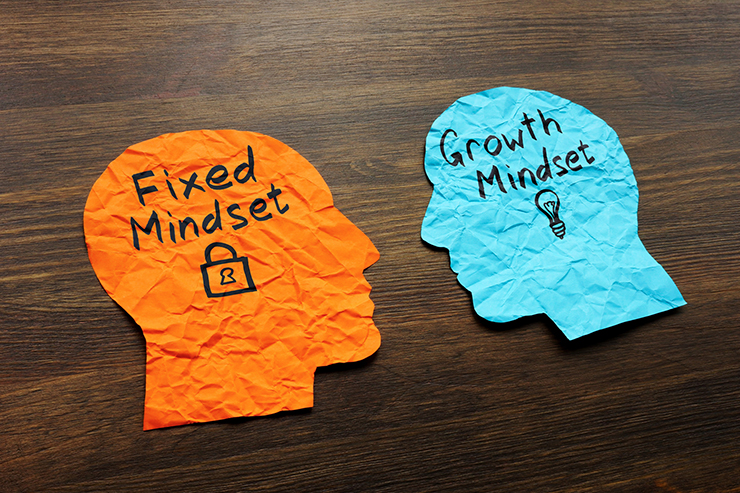
A fixed mindset assumes abilities and intelligence are static, while a growth mindset believes they can be developed through effort and learning.

James certainly exhibited a fixed mindset.

He saw the current challenges as beyond his control and doubted his leadership abilities were enough to overcome them. This mindset limited his capacity to adapt, innovate, and inspire his team.

This hindered his effectiveness and created a culture of fear and resistance to change. Team members became reluctant to take risks or propose new ideas, leading to stagnation and missed opportunities.

James needed to pivot quickly, or he risked losing his team and his company.

The Strategy

To jumpstart turning things around, we convened off-site for two days to set a vision for his leadership, craft an actionable strategic plan with immediate actions, and do some deeper interventional work to diffuse the origins of his fixed mindset.

We then worked over the next few months to continue cultivating his growth mindset and his abilities to deal with the internal and external challenges that his company faced.

The Shift

James’ team noticed the difference right away, and in the coming weeks and months, their morale and trust rose along with James’ ability to lead and the positive outcomes this produced. It was a pleasure for me to sit in on some of the meetings to observe and support James as he made incremental shifts that made a monumental difference.

How much of a growth mindset do you have? Check yourself here – how do you rate?

  1. I am confident and at ease in embracing challenges.
    • I view challenges as opportunities for personal and professional development.
    • I encourage risk-taking and innovation within the team.
  2. I appreciate learning from constructive feedback.
    • I use constructive feedback as a tool for growth rather than a personal attack.
    • I create an open environment where feedback is welcomed and valued.
  3. I persist in the face of setbacks.
    • I develop resilience by learning from failures and persevering through difficulties.
    • I share stories of past challenges and how they were overcome to inspire the team.

Here are some tips to foster a leader’s growth mindset:

  1. Practice Mindfulness
    • Engage in mindfulness practices such as meditation to increase self-awareness and emotional regulation.
    • Mindfulness helps leaders stay present, reducing stress and improving decision-making. Sarah can start her day with a brief mindfulness session to center herself and approach challenges with a calm and focused mind.
  2. Continuous Learning
    • Commit to lifelong learning by regularly reading books, attending workshops, and seeking new experiences.
    • Encourage the team to pursue personal development opportunities. Sarah can create a learning culture within her organization by providing resources and incentives for continuous education and professional growth.
  3. Surround Yourself with Growth-Minded People
    • Build a network of mentors, peers, and advisors who embody a growth mindset.
    • Engage in regular discussions with these individuals to gain new perspectives and insights. Sarah can join industry groups and networking events to connect with other growth-minded leaders and learn from their experiences.

Mindset matters—a lot.

The mindset of a leader significantly influences their effectiveness and the success of their organization. By shifting from a fixed mindset to a growth mindset, other leaders like James can transform challenges into opportunities for growth and innovation. Embracing challenges, learning from constructive feedback, and persisting in the face of setbacks are key steps in fostering a growth mindset.

Cultivating a growth mindset is an ongoing journey that can transform leadership effectiveness and overall organizational success. By practicing mindfulness, committing to lifelong learning, and surrounding themselves with growth-minded individuals, leaders can create a culture of growth and fulfillment within their organizations.

If you’re a leader feeling stuck, take a step back and ask yourself: Is it time for a mindset shift? You might be surprised at the doors it opens.


© Patti Cotton and patticotton.com. All rights reserved. Unauthorized use and/or duplication of this material without express written permission from the author is strictly prohibited. Excerpts and links may be used, provided that attribution is made to Patti Cotton and patticotton.com, with links thereto.

Patti Cotton

Patti Cotton reenergizes talented leaders and their teams to achieve fulfillment and extraordinary results. For more information on how Patti Cotton can help you and your organization, click here.

Do You Have a People Pleaser on the Executive Team?

March 11, 2020 By Patti Cotton Leave a Comment

Do You Have a People Pleaser on the Executive Team?
Image Credit: Shutterstock

Do you have a people pleaser on the executive team? Someone who might change opinions depending on which way the wind blows?

If so, you have a major trust leak in the team.

How can you tell if you have a people pleaser? And what can you do if you identify one?

Your people pleaser means well. In fact, this is his or her main driving force in life. But because they are busy making sure they fit in, people pleasers can’t support a particular idea or direction with integrity.

Sandy was a newly appointed executive in a large software tech company. One of the chief reasons she had interviewed well was that she exhibited a great deal of empathy.

“We needed more empathy on the executive team,” said Anna, the CEO. “In our world, tech can tend to come before people, and we were making an effort to infuse leadership with more human connection and understanding.”

“You are right to keep that in mind,” I answered. “We are losing human connection in the workplace. And empathy as one of the emotional intelligence traits is key in leadership.”

“She also brought a wealth of technical knowledge, so I felt it was a great combo,” Anna continued. “But I’m noticing that she can’t tether to a decision she makes. And she actually looks at other people to see what they are going to say before she offers an opinion.”

“This is serious,” I said. “It sounds like you have someone on the team who is stuck in what we call ‘the socialized mind.’”

“Well, whatever you call it, the team has started to distrust her. They don’t know how to take what she says or presents with any kind of certainty. She pretends to agree with everyone and seems to try to act like the people around her. A real chameleon. And she is constantly asking for feedback – seems to need praise to feel good. It’s exhausting.”

“Those are hallmarks of a socialized mind,” I responded. “This means she relies on the external world to tell her who she is and what value she brings.”

“It’s just not working,” Anna said. “I need someone who can contribute by bringing her own perspective and expertise to the mix. Someone who isn’t afraid to counter an opinion, but who can also negotiate to a great solution. When I tried to talk with her about this the other day, she just kept apologizing and started crying. I need your help.”

I met with Sandy, who was, of course, eager to please. It was clear she needed to show me that she understood and agreed with me, no matter what I shared. Not surprising, as we are all creatures of comfort who need to feel that we are accepted and safe. We took some time to become acquainted so that I could develop trust with her. I asked her what she felt was the challenge from her perspective.

“I just want to do the right thing,” she said. “Hearing what is needed is important to me. And I want to make sure I align with others’ thinking so I get it right.”

This showed me clearly that she was ready for growth. There were several things we did over the course of eight months that helped Sandy move from this people-pleasing state to one that was more tethered to her values and beliefs, even in the face of conflict.

A first phase in coaching Sandy was to help her recognize where she was trying to please others instead of standing true to herself as she negotiated solutions with the team. We began by doing some personal values work to solidify her sense of self and to use as a litmus when forming opinions.

At the same time, we identified her fears around carrying different opinions than her team members and tested out of this mindset trap in small ways so that she could become accustomed to disagreeing with others as it felt comfortable.

As her confidence grew, we explored key issues in her company and identifying multiple perspectives on how to solve these. Becoming comfortable with the complex and various ways to resolve such can be threatening to someone who needs to be right in others’ eyes. Working with real-time challenges with which she was familiar helped her to become more comfortable with weighing various options and seeing that more than one might be right.

Later, developing Sandy’s comfort and lens on seeing things as systems was important. The world is complex, and this can be overwhelming for anyone. A person of socialized mind can feel threatened by such complexity. Learning to first see complexity as a system and to become comfortable with the pieces in order to make decisions is key for today’s leadership.

Sandy’s team members rallied, seeing integrity in how she showed up and contributed. She felt the positive results and worked on developing closer relationships with each to strengthen her credibility.

The end result of our coaching? Sandy became a trusted contributor at the leadership level and the company benefited greatly, as well.

Download the Free Infographic

Fill out the form below and get instant access to the HOW TO RAISE YOUR INFLUENCE IN LESS THAN 5 SECONDS infographic.

Share0
Tweet0
Share0

© Patti Cotton and patticotton.com. All rights reserved. Unauthorized use and/or duplication of this material without express written permission from the author is strictly prohibited. Excerpts and links may be used, provided that attribution is made to Patti Cotton and patticotton.com, with links thereto.

Patti Cotton

Patti Cotton reenergizes talented leaders and their teams to achieve fulfillment and extraordinary results. For more information on how Patti Cotton can help you and your organization, click here.

Primary Sidebar

Patti Cotton
Tweets by @PattiCotton
  • About
  • Consulting
  • Training
  • Speaking
  • Blog
  • Contact
Home | Contact | Privacy Policy

© 2024 Cotton Group LLC | PATTI COTTON 360° LEADERSHIP®