• Skip to main content
  • Skip to primary sidebar

Patti Cotton

Executive Coach & Career Strategist

  • About
  • Consulting
  • Training
  • Speaking
  • Blog
  • Contact

direction

Keeping Your Head in the Game: Leadership 2021

January 6, 2021 By Patti Cotton Leave a Comment

Keeping Your Head in the Game: Leadership 2021
Image Credit: Shutterstock

It’s a new year, and the pundits are calling 2021 the Year of Transition. If anything has changed, it has been that we have acclimated to a new way of working and living.

There are definite perks to this, but there have also been major drawbacks which have caused us to abandon much of what we know and adopt a learner’s mindset out of necessity.

Admit it – it’s been rough. Many of you reading this are tired. And some of you have called me, asking me how you can get your head back into the game.

What does it take to reenergize and motivate you as leader so that you can lead your life and work in 2021?

I work primarily with top executives to recreate future, working with their respective teams and companies, and also in small leadership groups where CEOs can put their heads together to share experiences and ideas. When we work on meeting the future, motivation of self is a hot topic.

And here is what we know: the head game of motivation requires that you focus on three things:

1. Purpose

Energy and engagement come from purpose. After weathering the initial shock and challenges of 2020, your physical and mental stores may be depleted. Revisiting your purpose is a first necessary step to picking back up. Why do you lead? What impact do you hope to make? What legacy are you seeking to create? If you keep pushing forward but cannot answer these questions, you will be headed for burnout. I invite you to take time to reflect on this. Call a coach or trusted advisor and talk through this. Because anything sustainable starts with purpose.

2. Direction

Know where you are headed. It is true that long-term planning is no longer valid due to the volatility and uncertainty around the future of work. Instead, one must use shorter-term planning to head in a general direction, and continuously bench against the changes in the business landscape. Keep your organizational vision at the forefront as you acquire the personal agility needed to meet goals and objectives. This particular step requires that you also open up to the perspectives of others. Seasoned leaders are comfortable doing things in the familiar way. And the word familiar is one that will not be used often in 2021.

3. Synergy

Leadership has been lonely, but then, we haven’t learned how to share it very well. Leading forward now requires the shift from “me” to “we,” for connection, mutual support and collective accountability. Inviting your executive team to share the vision is a first step, but the next is to allow them to share in greater responsibilities – the kind that ignites their purpose, as well. Raising the tenor of team energy is the magic we need to create great things together. Where do you start? Begin with a conversation around this topic. Ask for their ideas and feedback, ask what it would take for them to get excited around the idea. I believe this might be one of the most meaningful brainstorming you will have experienced for a long time – and it can yield great fruit.

My wish for you in 2021 is to know that you have what it takes (I know some of you question this at this time). My challenge to you is to rediscover your purpose and direction, and to create that synergy that will lift you up, as well as your team, so that you can move confidently to meet the future.


© Patti Cotton and patticotton.com. All rights reserved. Unauthorized use and/or duplication of this material without express written permission from the author is strictly prohibited. Excerpts and links may be used, provided that attribution is made to Patti Cotton and patticotton.com, with links thereto.

Patti Cotton

Patti Cotton reenergizes talented leaders and their teams to achieve fulfillment and extraordinary results. For more information on how Patti Cotton can help you and your organization, click here.

The Clockwork of Excellent Leadership: 3 Essential Gears

August 9, 2017 By Patti Cotton Leave a Comment


What makes up excellent leadership?

The workings of excellent leadership are essentially the same, whether you are a small business owner or a large corporate executive. It doesn’t matter what the industry, in which country or countries you do business, and whether your staff is comprised of millennials or seasoned mentors (and I hope you have both!).

What constitutes excellent leadership remains constant.

Imagine, if you will, the business of leadership to be a finely-tuned clock. With this picture in mind, now imagine you are looking at the inside of the clock and that you see three interlocking gears, well-oiled, all turning together to support the clock’s movement. That’s good leadership.

Let’s go further with this analogy. Suppose one of the gears stops working. It gets rusty, or wears down so that one of the teeth breaks off. What happens then? Of course, the gears stop turning, or they turn for a while, begin to misbehave, and then slow to a halt.

Leadership is the same way. The essential components that go into leadership must all work together, or they begin to wear on one another and bring things to a stop.

What are these three “gears”? And how do they work together?

The First Gear: Vision

Vision is the answer to “what’s possible.” It’s where things start – and indeed, one cannot move forward without some kind of vision, some sort of mental picture of what ultimate success can look like.

For an enterprise, vision is the desired future impact the entity aspires to make. It represents the overall goal and global direction of the business, and this rarely changes.

You can see what I mean by the examples of some well-known visions here:

Disney:                        To make people happy.

American Express:      To be the world’s most respected service brand.

Hilton Worldwide:       To fill the world with the light and warmth of hospitality.

In the world of leadership development, much focus has been given to the ability to vision.

Being able to visualize and articulate what is possible for the future of an enterprise is considered a vital component of successful leadership. By the same token, many leaders have been known to fail because of their lack of vision. Indeed, first being able to capture vision, then inspiring it, holding fast to it despite constant change, and keeping one’s eye on it while doing the work required to get there is a huge challenge.

Here are just a few reasons why you and your enterprise require vision – and why it must be defined before you make any moves forward.

  1. Focus

     If you have the end goal in mind, you can focus on it, and thus eliminate shiny objects and other distractions along the way. In the workplace, focus helps you give attention to the right things that will help you reach vision.

  2. Direction

    Vision is your ultimate destination and, when you don’t know where you are going, you might as well drive down any road and just keep traveling. In the workplace, no direction means you are liable to land anywhere – and nowhere specific. That’s death knell for business.

  3. Meaning

    Vision gives context to what you do. It reminds you of the “why” of your enterprise, why it exists. In the workplace, executing your work without understanding why you are doing what you do means disengagement and dissatisfaction.

  4. Motivation

    When you know where you are going and why, this is motivating. You can see as you take action and get closer to goal, and this energizes you. When your employee base is motivated, you will see high engagement and productivity – the stuff that keeps a business going well.

  5. Inspiration

    Vision is inspiring. It’s a lofty and attractive goal that may seem unattainable, but that keeps you climbing toward the top. As you are energized and engaged, so is your staff. They “catch” the vision through your ability to visualize it and articulate it to them so that they can also strive to get there with you.

The Second Gear: Strategy

Strategy is the plan of action for going after the vision. It’s the question, “What is the best way to get there?” Strategy is key to driving direction, and seeks to take the best path to get to the vision. Best ways “to get there” can change, depending on unpredictable market conditions, competitors, disruptive technology, and many other factors.

If you work in a large enterprise, your company or organization is comprised of business units, and these may have multiple teams. Each of these units and each of their teams has a set of strategies to support the larger, more global corporate strategy, which supports the entity’s vision. If you are an entrepreneur or smaller business owner, you will have equally important strategies defined, but less of the strategy “layering” that a larger entity would have, in order to support your enterprise’s vision.

The Clockwork of Excellent Leadership:   3 Essential Gears

What makes up excellent leadership? The essential components that go into leadership must all work together, or they begin to wear on one another and bring things to a stop. Learn how to keep them running like clockwork. Sign up to receive the  complimentary infographic.

Here is how one company redefined a key business strategy because of a changing marketplace.

For years, there were just a few large credit card companies to service the population, and American Express was one of these. However, in the early 2000s, competition rose, with newer companies worldwide offering online payment processing. This meant that American Express risked losing its market share and revenues, compromising the future growth and sustainability of the company (“American Express Redefines Its Strategy,” ICMR IBS Center for Management Research, 2015).

American Express was in a pickle. It had no more premium products it could offer its current customer base in order to offset this. So American Express leadership sat down and analyzed current trends, examined its target market, and reviewed its strategy. Leadership realized that in order to remain competitive and minimize any possible loss, it must branch out to target additional populations, and by doing so, adopt a different business strategy to reach these groups.

Previously, the company had targeted customers based on how much they spent, and not on how many transactions they made. It had built its reputation on being the “elite” card in the credit world. Now, leadership was forced to redefine itself as a more accessible company to the general population. It added a new business strategy by targeting a market that spent smaller amounts than the first group of customers, but made many more transactions. In 2014, it launched a new credit card for housewives and students called the “Amex Everyday” credit card and some other products for the mass population.

As you think about the American Express story, recall that its vision is “to be the world’s most respected service brand.” Notice that this did not change. Leadership simply made sure that the business strategies used changed to adapt to marketplace demands so that it could still meet the vision.

To visualize this a bit more easily, let’s say that your vision is to reach the city of Rome. One of your key strategies is to take the fastest and most economical routes in order to arrive at your ultimate destination more quickly and with a lion’s share of the money you have put away for your trip.

The Third Gear: Execution

Henry Ford once said, ‘Vision without execution is just hallucination.” Execution is implementing the actions dictated by the strategies that will support the vision. Obviously, if strategy isn’t executed in order to support reaching the vision, nothing gets done.

This is more common than you might think. I have encountered many a leader whose head is stuck in the clouds all day, dreaming of the vision, while unaware of what strategies his workforce is carrying out, and whether they are executing effectively. Once in a while, these leaders are confronted by real problems in the real world (theirs!), and it is difficult for them to make good decisions and take the right action, since they haven’t been in touch with what is happening in their business to meet the vision. They model what the rest of the enterprise eventually adopts – and down goes another business.

But execution – the carrying out of actions dictated by strategy – must be effective in order to work. This requires implementing in the right way – with the right thoughts and behaviors. This is where a lot of leadership calls me for help – and quite often for themselves.

You’ve probably experienced a leader who cannot communicate well. He or she delivers nebulous messages that no one can understand. Not wanting to ask repeatedly for clarification, people go away, trying their best to guess what the leader wants as they go back to put plan into action. They will no doubt make mistakes that could have been avoided.

Perhaps you have worked with a leader who doesn’t listen well, or doesn’t have a strong empathy quotient. This person can offend others easily and cause rifts in relationships.

What about a leader who cannot stay focused? This leader may change directives at whim, causing confusion and conflict among groups and teams. These are just some behaviors that get in the way of sound execution.

Although there are quite a few more, here are five common problems that may hold a leader back because their behaviors don’t support good execution.

Have you worked with someone who needs more of the following?

  1. Personal Agility

     The ability to flex well and deal with change to support the situation, whether interpersonal or organizational.

  2. Building Trust

    The ability to conduct self with consistency and integrity to develop solid trust with others.

  3. Conflict Management

    The ability to manage conflict effectively so that the problem and its root cause are solved, and so that relationships are strengthened.

  4. Initiative and Bias for Action

    The ability to take initiative in timely decision-making and action-taking to benefit the enterprise.

  5. Communication

    The ability to convey clear and concise messages, and to do so in a way that all levels of the enterprise understand directives, feel informed, and are confident as to the intended direction and outcomes.

If you or a leader you know has a behavior that gets in the way of his leading, take heart. This can be successfully shifted through executive coaching with the right methodologies and approach, to benefit the person’s execution and the future of his enterprise.

Why Vision, Strategy, and Execution as Three Gears Need to Work Together

Imagine a vision without a way to get there. Imagine strategy without an ultimate destination creating the right pathway. And think about actions that have no meaning or reason to implement them.

Many enterprises tell me they have a clear vision, strategies to support this, and good execution. Yet, many times, I find there are no processes to make sure that these three gears remain viable and aligned.

Often, I encounter an executive team who insists its strategies are right for the company. “These have always worked for us,” I may hear. This is good. But beware – what works today will not work tomorrow. You are endangering your enterprise if you are not continuously assessing your strategies and how these meet demands and changes.

Then, I’m likely to hear how a company has the right vision and strategies, and that people are busy. Leadership cannot figure out why the enterprise isn’t seeing better outcomes. If this is you, it’s time to investigate!

As an example, I talked with a middle manager about putting together an action plan to help motivate his team. He responded, “Oh, we know how to put an action plan together. We have one, and we are busier than ever. But I’ll tell you, nothing good will happen until we get permission to take the right actions. Our projects and initiatives don’t often support the larger goals in the first place. And I ask myself, ‘Why are we here?’”

Do you have your vision, strategies, and execution aligned? Is your enterprise where you want it to be? I can promise you that if your response is no, the answer lies in a needed realignment in at least one of three areas.

Excellent leadership begins now – with an intervention to bring all back into clockwork order.

Patti Cotton

Patti Cotton reenergizes talented leaders and their teams to achieve fulfillment and extraordinary results. For more information on how Patti Cotton can help you and your organization, click here.

Getting Your Bold On

December 7, 2016 By Patti Cotton Leave a Comment

shutterstock_229429621a

Are You a Gambler or a Calculated Risk-Taker?

There’s a fine line between taking a calculated risk and being a reckless gambler – and you can win or lose big, either way. However, in today’s business world, it is necessary to take risks in order to remain competitive and ahead of the game.

How do you do it so you don’t lose your shirt?

Whether you are an executive, business owner, or other professional, risk-taking is a key factor in your ability to lead yourself and others into the future. It affects your direction, decision-making, choices, and actions. It is the difference between becoming a Vera Wang or Elon Musk – or a Jane Doe or Joe Blow.

Can you become a calculated risk-taker – and win?

Deborah Perry Piscione, author of Risk Factor, says yes. Piscione, a member of former congressional and White House staff, as well as a media commentator for several key news channels, now supports some of the greatest risk-takers in Silicon Valley where technology history is made. She and some of her colleagues have conducted research that reveals the “DNA” of bold risk-takers, and they have discovered several key attributes – all of which can be cultivated.

These traits include such things as refusing to accept the status quo, being in touch with a much greater purpose in life, valuing talented people and understanding how and when to collaborate with them, and being able to effectively execute an innovative idea or direct others as they do it.

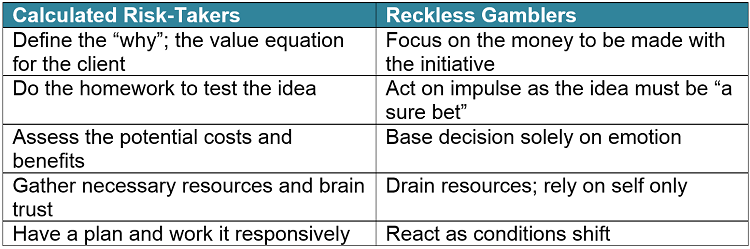
Indeed, in my coaching practice, I’ve observed 5 ways accomplished risk-takers differentiate themselves from gamblers:

risk_chart

But at the foundation of all of this is to have a lower level of fear than most people, or even an absence of fear. Because it is fear that keeps us from considering those decisions and actions that are outside of the box, and that will take our business and career from safe and small to extraordinary.

So we tell ourselves that people must just be born with a risk-taking quotient, and that it doesn’t run in our family. This is our excuse for removing ourselves from the equation. We then step back into our ordinary space, playing it safe and small, while others take the leaps and celebrate the rewards.

However, risk-taking isn’t a genetic trait – it’s acquired. You can, at any age, acquire the tools, skills, and knowledge to become a calculated risk-taker, and learn to avoid the pitfalls of those encountered by the reckless gambler.

So it’s back to confronting and overcoming the fear, because the approach to risk-taking can be learned. I’ll be writing about a specific method I use with clients to do this in my next article.

But meanwhile, what fear is holding you back from getting what you want?  And how do you move past it? Join us on LinkedIn to share, and for more discussion.

—

Patti Cotton helps women executives optimize their effectiveness in leading self, others, and enterprises. Her areas of focus include confidence, leadership style, executive presence, effective communication, and masterful execution. With over 25 years of leadership experience, both stateside and abroad, Patti works with individuals, teams, and organizations across industries, providing executive coaching, women’s leadership development, change, and conflict management. She is also a Fortune 500 speaker. For more information on how Patti Cotton can help you and your organization, click here.

Patti Cotton

Patti Cotton reenergizes talented leaders and their teams to achieve fulfillment and extraordinary results. For more information on how Patti Cotton can help you and your organization, click here.

Primary Sidebar

Patti Cotton
Tweets by @PattiCotton
  • About
  • Consulting
  • Training
  • Speaking
  • Blog
  • Contact
Home | Contact | Privacy Policy

© 2024 Cotton Group LLC | PATTI COTTON 360° LEADERSHIP®