The Harvard Business Review (HBR) has just come out with its annual list of 100 best performing CEOs in the world.
Who are these leaders and what makes them different?
The team at HBR uses tough criteria to identify and rank these CEOs, assessing their capability to lead in a volatile world.
How do you measure such capability?
Outcomes.
Quite a bit of HBR’s process involves reviewing the profitability and forward movement of the company, seeing how well it sustains momentum in the midst of challenging outside forces – “savvy competitors, demanding customers, profit-hungry investors, political and economic headwinds” (Best Performing CEOs in the World 2018).
How would you measure up?
Is it fair to judge you as leader when external forces aren’t in your control?
Yes and no.
You certainly cannot change or control external forces.
But you can change the way you meet them.
And this is exactly how these 100 best performing CEOs became part of HBR’s list.
Of course, vision, strategy, and focused action all played into successful outcomes. But what makes the difference for winners once the plans are in place are two things: steadiness and stability.
That’s right – steadiness and stability.
Sound dull? These are two of the most underrated traits in leadership – and yet, two of the most important.
Steadiness is the ability to continue pushing through even at the toughest times so that you can emerge from the toughest of maelstroms. And stability is a foundational strength that provides focus, security and safety.
It stands to reason that, unless you can lead with steadiness and stability, you will compromise your targeted success.
I recall a time in my younger years when my then 35-year-old father left his teaching position to develop healthcare facilities. His vision and strategy were sound, and against all odds, he first developed a retirement center, a convalescent and rehab center, and a hospital all within three years. The city sorely needed these facilities – even the hospital which was just a mile from a larger more established one. The administrator of the latter had shared with Dad that they needed overflow facilities and if Dad would develop a community hospital, there were patients waiting.
So Dad began developing these with a passion and determination that were unparalleled. But he met with great resistance. Someone in town complained that if another hospital was built, that his dog would be nervous. Someone else tried to get in front of Dad and quickly develop a hospital before he did, even after Dad had procured the licenses and permissions necessary to break ground. There were fights and opposition all around. And 16 City Council hearings. Sixteen.
I reflect on that and ask how many people would have weathered all this at 35 years old. In the end, he won – and so did the town, which has benefited from these facilities for several decades, now.
But Dad could not have done this without unwavering steadiness – the commitment to push through even when incredibly discouraged and feeling alone. He could not have done this without the stability that his vision gave him – the strength and commitment to move with focus.
How would you rank your steadiness? And your stability in the face of opposing winds?
Here is my personal challenge to you for growth:
- During this upcoming holiday season, I invite you to reflect on those times when you have faced difficulty, but still pushed through to successful outcomes. Celebrate this!
- Ask yourself where there is room for more steadiness in your leadership…more stability. What stretch goals do you have for yourself, your team, for the company – and how will these traits play into reaching them?
Are you interested in developing greater leadership capacity in your work and life?
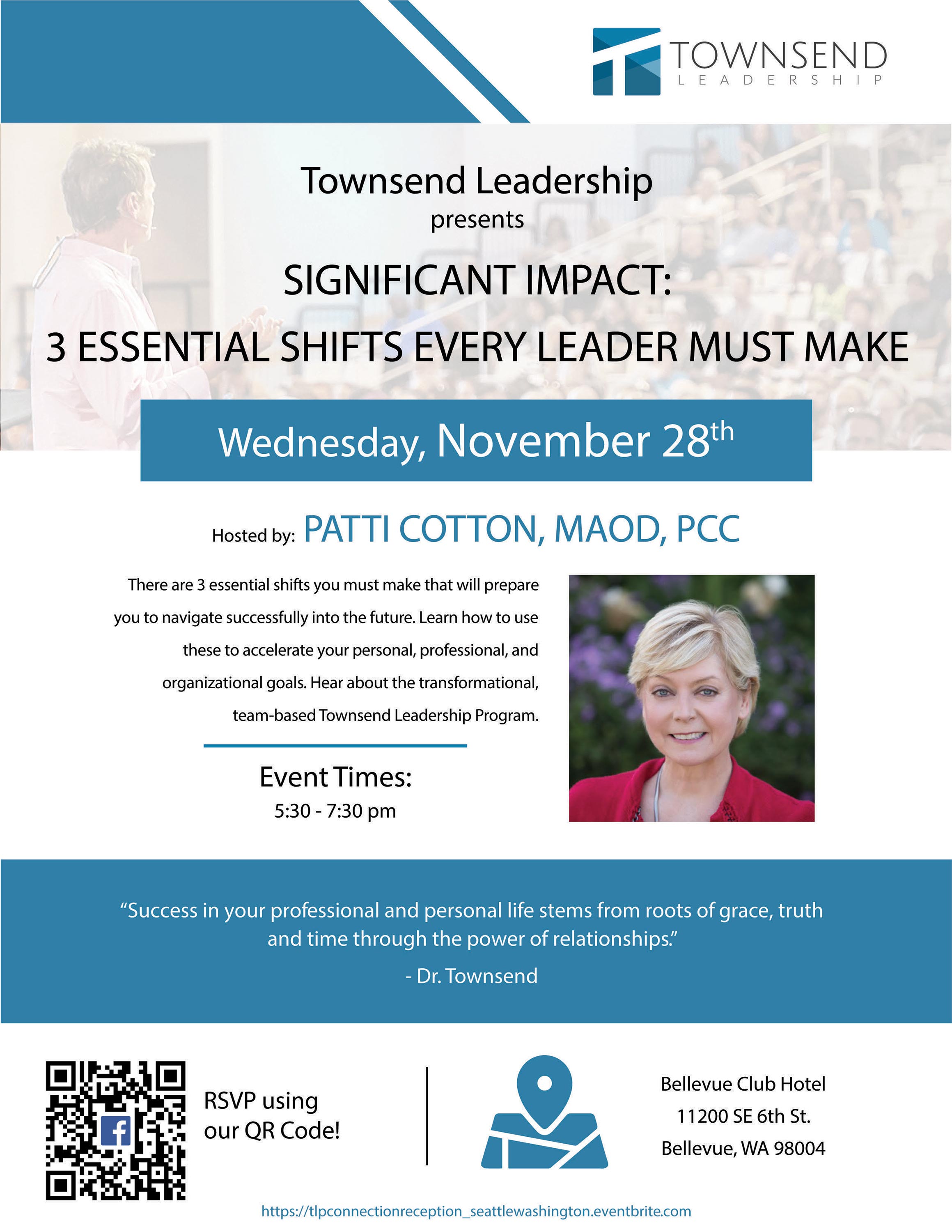
Come and join me at the Bellevue Club Hotel in the Seattle area on November 28 to hear more about how you can do so. Seating is limited and folks are flying in to attend, so please rsvp only if you are sure you can be there: https://www.eventbrite.com/e/3-essential-shifts-every-leader-must-make-tickets-51973207262.
Or for Southern California leaders, e-mail me at patti@patticotton.com for details of a private upcoming event in the Inland Empire.

Patti Cotton reenergizes talented leaders and their teams to achieve fulfillment and extraordinary results. For more information on how Patti Cotton can help you and your organization, click here.